Exhibition
Opened 8 March
The ancient Egyptians believed the soul lived on after death, and that the body had to be preserved so the soul would find it in the afterlife.
The exhibition tells the story of the four sarcophagi and mummies in the museum's collection: Ankhsenmut, Paenhor, Dismutenibtes and Nofret. They lived rich, full lives in a period after Ancient Egypt’s greatest heyday — singing in the temple and playing on the banks of the Nile.
Death was not the end for the ancient Egyptians; as long as their name was spoken, they lived on
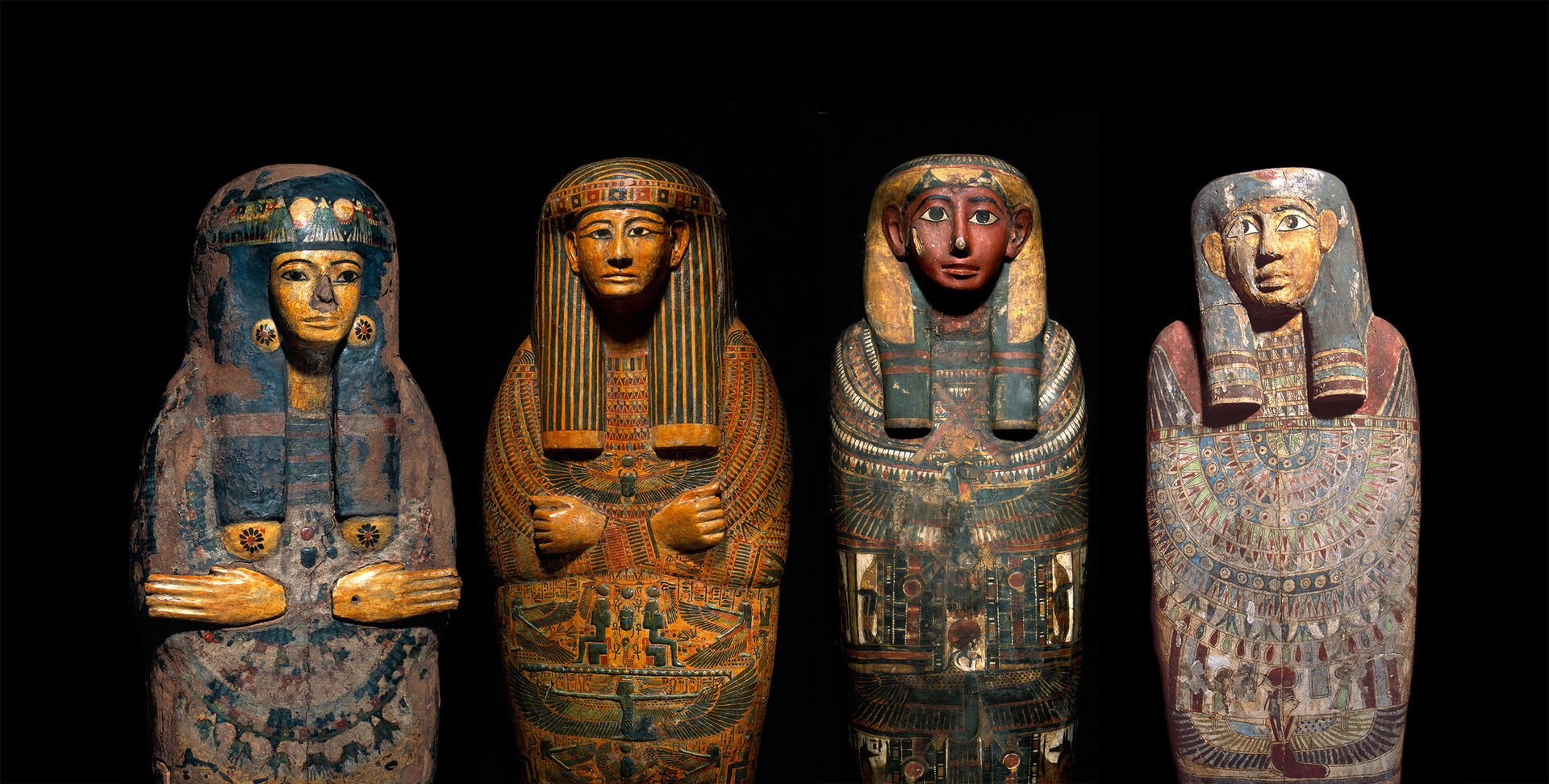
In the tombs, loved ones placed gifts and items meant to help the deceased on the journey to eternal life. On display are mummies and coffins alongside a rich assortment of amulets, scarabs, god and animal figures. In addition to papyrus, canopic jars used to keep the decieced organs, and ushabti, small figurines that were put in the burial site, which tell of burial rituals and the belief in the afterlife.
Visiting with children
The exhibition is made for all ages. You are welcome to discover stories about lives, beliefs and objects from one of the world’s most fascinating ancient civilizations.
Discover beautiful details on Paenhor's coffin in 3D
The forgotten mummy family
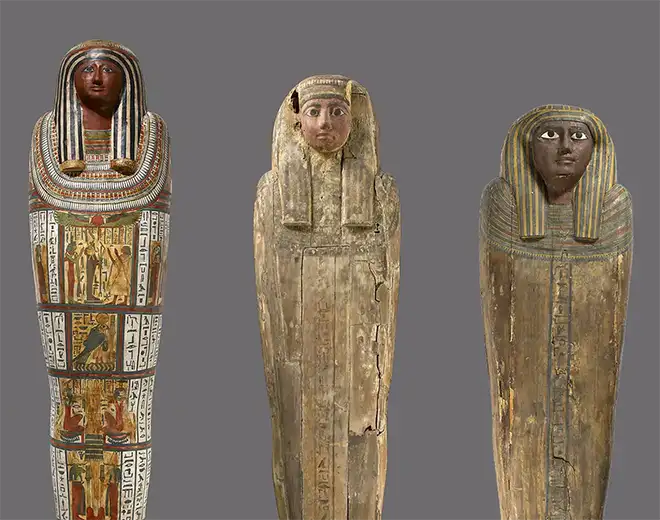 When the mummy Dismutenibtes was donated to the University of Oslo in 1838, no one knew that her husband and son had ended up in entirely different museums across Europe. The story remained forgotten for nearly 200 years.
Why are the mummies in Norway?
The Egyptian objects in the museum’s collection were received as gifts. Most arrived in the 19th century, when European museums were building large Egyptian collections. The most recent Egyptian object came in 1962. Today the Museum of Cultural History, of which the Historical Museum is a part, does not actively acquire antiquities or Egyptian objects.
More on the origins of the artifacts
The mummy we call Dismutenibtes came from Thebes. It was acquired by the Armenian Giovanni Anastasi, who served as the Norwegian–Swedish consul‑general in Alexandria. The mummy was donated to the Royal Frederick University (now the University of Oslo) in 1838.
The mummy we call Nofret came from Akhmim. In 1889 it was presented to King Oscar II by the German Egyptologist Heinrich Karl Brugsch. The king then passed the mummy on to the university’s ethnographic collection.
The museum’s largest single Collection from Egypt originates from a mass find at Deir el‑Bahri in 1891. More than 150 priestly mummies had been hidden away in antiquity. When they were discovered, the Egyptian Museum in Cairo was unable to manage such a large find, so the objects were distributed to several European countries as gifts from Khedive Abbas II of Egypt. This is how two yellow mummy coffins from Egypt’s 21st Dynasty came to Norway — the coffins we now know as Ankhsenmut and 'Paenhor'.
Today the Museum of Cultural History does not actively acquire objects from antiquity or from Egypt. The 1970 UNESCO Convention regulates the trade in cultural property; Norway committed to the Convention in 2007, and Norwegian laws have been adjusted accordingly.
The Historical Museum is part of the Museum of Cultural History at the University of Oslo.
On displaying human remains
The exhibition includes human remains. This imposes ethical requirements on how we handle ancient human remains in our collections
Displaying preserved human bodies raises ethical questions about how we treat ancient remains in our collections. Historically, human remains in museums around the world have often not been treated with the respect they deserve.
This exhibition focuses on the people who once lived. Where known, we refer to humans by their given name. Ancestors from Egypt are displayed in a manner where the remains are not directly visible to the public. In addition, the exhibition space is intended to instill a respectful environment.
Exhibition credits
The exhibition’s project group consists of museum staff.
- Project owner: Toril Rokseth
- Curator: Marina Prusac-Lindhagen
- Project manager: Benedicte Sunde
- Exhibition design and graphic design: Johnny Kreutz
- Education and public outreach: August Myrseth
- Conservation: Ingrid Gudmestad, Sophie Louise Rowe, Anne Håbu, Angeliki Zisi
- Collections manager: Anette Sættem
- Photography: Lill-Ann Chepstow-Lusty, Ellen C. Holte
- 3D: Sjoerd Joost van Riel, George Alexis Pantos, Justin J.L. Kimball
- Communications team: Øivind Gulliksen, Ida Marie Bjørknes Gaarder, Tea Kristiansen, Karoline Dowson
- Exhibition technicians: Hugo Strand, Inge Bugge Knudsen and Jakob Skarveland
Press contact
A part of the Collection of Egyptian antiquities
Funding
We acknowledge the valuable support of the Bergersen Foundation in providing funding.