Temporary exhibition
In Viking Age Scandinavia (800–1050 AD), gods and mysterious natural forces were part of everyday life. Much about Viking beliefs remains unknown—but fragments endure. Their artifacts, beautiful and unique, hold traces of ancient tales about gods, heroes, and dragons.


World premiere
The serpent head from the world’s best-preserved Viking ship, the Oseberg, has never been displayed before. Too fragile for exhibition, it’s been kept in storage—until now. For the first time, see the original carving in all its glory. All the objects displayed in this exhibition will be relocated to the Viking Age Museum when it opens its doors.
Explore together as a family
- Enter the Serpent’s Lair—a hole filled with snakes!
- Write your own runes—craft a secret viking message
- Meet the Norse gods Thor, Odin, and Freyja
- Try your hand at weaving—learn how Vikings made clothes and sails for their ships
- Can you spot Ratatosk? This mischievous squirrel has tales to tell
Humans have always sought answers to life’s mysteries. Myths explained the unexplainable—from thunder to the world’s end.
The gods and creatures of the vikings you will encounter in the exhibition
Yggdrasil
Yggdrasil is the Tree of Life, and the Vikings believed it connects the worlds of Asgard, Midgard, and Utgard. The gods and the Norns live in Asgard, humans live in Midgard, and the giants live in Utgard. The giants and the gods constantly argue.
Many intriguing creatures live in Yggdrasil, such as the squirrel Ratatoskr. He runs up and down the branches, spreading news and gossip.
Odin
Odin is the god of war, magic, and wisdom. He is the oldest and most powerful of the gods. To gain more wisdom, he sacrificed one of his eyes in order to drink from Mimir's well, which is a magical well full of knowledge.
Odin lives in the magnificent Valhalla. From there, he sees everything that happens in the world. He likes to disguise himself and walk among humans, wearing a large hat and a blue cloak.
Odin rides the horse Sleipnir, which has eight legs and runs faster than the wind! He also has two ravens, Hugin and Munin. He sends them out into the world every day, and when they return, they sit on his shoulders and tell him everything they have seen and heard.
Vikings who die in battle go to Odin in Valhalla. They eat and drink well, practice their warfare skills, and prepare for the battles of Ragnarok, the end of the world.
Thor
Thor is the god of natural forces, strength, and fertility. When he drives across the sky in a mighty chariot pulled by goats, lightning and thunder follow.
Thor is the son of Odin. He enjoys having fun, but he is also hot-tempered and never goes anywhere without his hammer Mjölnir. He always hits what he aims for when he throws his hammer, and it always returns to his hand. He protects gods and humans from the giants. Once, he disguised himself as a bride in a wedding dress to trick the giant Thrym!
The Norns
The Norns are goddesses of fate. They are three magical women who determine how the lives of gods and humans unfold. Their names are Urd, Verdandi, and Skuld. Urd weaves the past, Verdandi weaves the present, and Skuld weaves the future. Every human and god receives their own thread. The length of the thread determines the length of life. The Norns tend to and care for the tree Yggdrasil.
Freyja
Freyja is the goddess of love and fertility. She is beautiful and wise and loves everything that is beautiful in nature. Anyone who is in love can ask Freyja for help. She is also the goddess of death and seidh, a special kind of magic used to create life and help humans. She has a sled pulled by two lightning-fast cats, and she enjoys traveling around the world to help people.
Ratatoskr
Ratatoskr is a squirrel that lives in the tree Yggdrasil. He is quick and curious. He loves gossip and keeping up with what is happening. He runs up and down the tree with news. Although he can be a bit mischievous, he helps maintain communication between the different worlds!
The Midgard Serpent
The Midgard Serpent is an enormous and fearsome serpent. The serpent is the sibling of the feared wolf Fenrir and the goddess of death, Hel. The gods have heard a prophecy that states these three will bring misfortune. Odin therefore throws the Midgard Serpent into the sea, Fenrir is bound by the gods in Asgard, and Hel is sent down to the realm of the dead.
The Midgard Serpent lies curled around the outer edge of the ocean and bites its own tail. That way, it holds the human world together. Thor and the Midgard Serpent hate each other. Thor almost managed to kill the serpent once, but it escaped. They will meet again when Ragnarok, the end of the world, arrives.
The wolf Fenrir
The wolf Fenrir is a very large and terrifying wolf. He is the sibling of the Midgard Serpent and the goddess of death, Hel. Because he is so dangerous, he is bound by the gods in Asgard. He is so immensely strong that the gods asked the dwarves to forge a magical chain called Gleipnir to hold him. However, when Ragnarok comes, Fenrir breaks free. The wolf races towards the plain where the final battle of the war takes place. His jaws are so wide that when he opens his mouth wide, his snout reaches all the way up to the sky. Fenrir swallows Odin. Odin's son, Vidar, avenges his father and kills Fenrir.
Free admission for children
Free admission to the museum for people under 18.
More about the Serpent Head
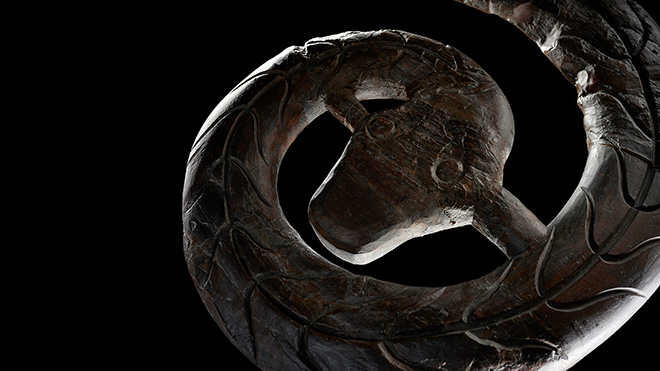 Today, this cultural historical treasure is perhaps the foremost symbol of the Viking Age. Paradoxically, we can thank the grave robbers for it not being lost along the way.
Join us as we carefully relocate the Serpent Head to the exhibition
Exhibition credits
- Exhibition Design: BOLT Design Studio
- Animation: Camerat
- Installations: Norwegian Toolbox
- Lighting design: Kyndill
- Exhibition mount maker: Dekorverkstedet
- Production: Prototyper
Museum project team:
- Project owner: Toril Rokseth
- Research advisors: Hanne Lovise Aannestad, Elisabeth Maria Magin, Ingunn Marit Røstad
- Project manager: Benedicte Sunde
- Education and public outreach: August Myrseth
- Conservation: Guro Hjulstad og Elin Christine Storbekk
- Collections manager: Hanne Lovise Aannestad
- Graphic design: Johnny Kreutz
- Photo: Alexis Pantos, Kirsten Helgeland
- 3D: Stefan Magnus Xara Brazil Fongen, Håkon Oroug Larsen, George Alexis Pantos
- Communications team: Øivind Gulliksen, Tea Kristiansen, Karoline Dowson, Ida Marie Bjørknes Gaarder
- Exhibition technicians: Hugo Strand, Inge Bugge Knudsen, Jakob Skarveland
- Blacksmith: Anders Helseth
- Textile education and outreach : Helene Olsen
- Illustrations: Trym Sakariassen, Rune Markhus












