The Oseberg grave was excavated by archaeologists in 1904. Today, the Viking ship consists of about 90% original wood, making it the best-preserved Viking ship in the world. However, the serpent's head was too fragile to be mounted on the ship, so an exact replica was made, which now sits at the front of the ship.
Since then, the serpent head has been stored in controlled conditions in the museum’s storage. It is in relatively poor condition and vulnerable to damage. Now, it will be displayed under strictly regulated conditions to ensure its preservation.
The Incredible History of the Serpent Head
When archaeologists excavated the Oseberg grave in 1904, they found a Viking ship that had been hermetically sealed in thick layers of clay for over a thousand years. Optimal preservation conditions meant that the wood and metals were largely untouched by time. Ship equipment, kitchenware, farming tools, three ornate sledges, and a horse-drawn cart with beautiful carvings were among the items archaeologists recovered.
The Oseberg ship was built around the year 820. Fourteen years later, it was dragged ashore and used in a ship burial for two women. The grave was covered by several meters of stone and clay. In the latter half of the 10th century, grave robbers caused significant damage to the burial mound. In the process, they also hacked off the prow ornament and threw it further down the tunnel they had dug, where it remained protected. Had it been left at the top of the ship, it would likely have rotted away and been lost.
The Significance of the Serpent Head
In Norse mythology, serpents and other animals played an important role. The Midgard Serpent was the name of the enormous serpent that encircled the world of humans. It is also known that there were Viking ships named Ormen Lange (The Long Serpent). The serpent head on the Oseberg ship may have served as a connection between the ship and the mythological world.
It is not unlikely that the serpent head on the Oseberg ship could be removed and reattached. A law from 12th century Iceland states that the prow ornament must be taken off when approaching land to avoid angering the land spirits. The Bayeux Tapestry (depicting the Norman conquest of England in 1066) shows how ships had their prow ornaments at sea but removed them when coming ashore.

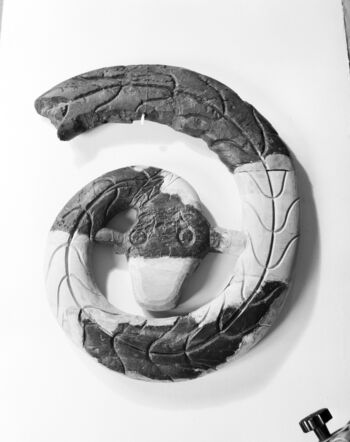
The serpent head. Its distinctive spiral curl.
Photo: Alexis Pantos/Historical Museum

The Oseberg ship. The prow ornament is too fragile to be mounted on the ship.
Photo: Mårten Teigen/Historical Museum

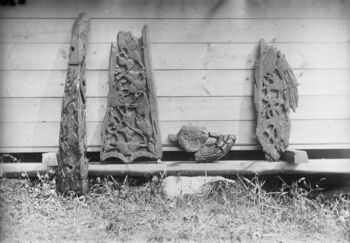
Parts of the stem post (stempost, "tigelen," and serpent head) and railing decoration ("brandr") from the ship.
Photo: Unknown

The three original parts are attached to a restoration made of modern wood and filler material.
Photo: Unknown

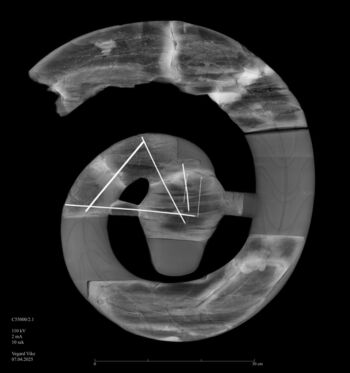
The X-ray image reveals the different components and the large metal pins holding the wood together.
Photo: Vegard Vike/Historical Museum


Family Exhibition on Norse Mythology
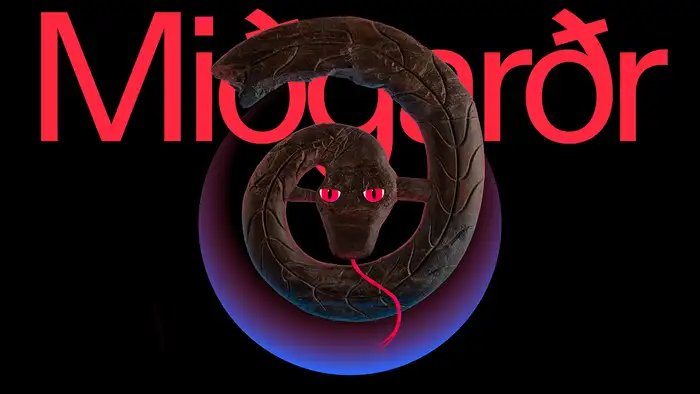
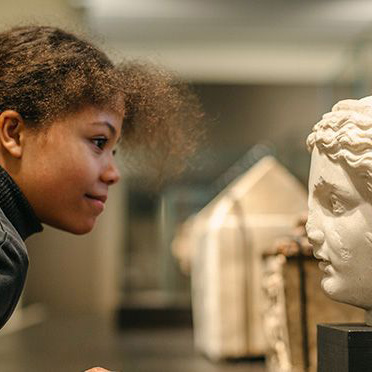
The exhibition Miðgarðr – The Mythical World of the Vikings is a family-friendly journey into the spiritual universe of the Viking Age, specially designed for children aged 8–12. Through artifacts, activities, and storytelling, children can become familiar with Norse mythology and Viking life.
The serpent head and other Viking artifacts in Miðgarðr will be displayed at the Historical Museum for a few years before moving to the new Viking Age Museum at Bygdøy. There, the serpent will be reunited with the Oseberg ship and the rest of the Oseberg finds after 120 years.
Both the Historical Museum and the Museum of the Viking Age are part of the Museum of Cultural History.
The Oseberg Ship:
- Built around 820. Used as a burial ship in 834. Excavated by archaeologists in 1904.
- 21.5 meters long and 5 meters wide.
- 15 oar holes on each side—fully manned with 30 rowers.
- The best-preserved Viking ship in the world, consisting of about 90% original wood. The rest has been replaced with newer wood.