
Temporary mini exhibition
The last day open to the public is 8 November
In this exhibition, you will get a close look at the very first Norwegian krone coins and banknotes that came to light.
From the Middle Ages until 1875, Norwegians used daler and skilling when buying and selling goods and services. In that year, the Norwegian krone was introduced when Norway joined the Scandinavian Currency Union, which aimed to simplify economic trade between the three countries. The new Danish, Norwegian, and Swedish krone coins were valid in all three Scandinavian countries. The first krone indicated its value in both skilling and kroner. The coin bears the inscription "Broderfolkets vel," which can be translated as "the welfare of the brotherly people". This was the motto of the union king Oscar II.
From the very beginning, the Norwegian krone has been an important national symbol, in times of prosperity and adversity. Norway was in union with Sweden when the krone was introduced, and this was a period of hardship as various forces fought for an independent Norway and for Scandinavian unity.
Norway's Most Valuable Banknote
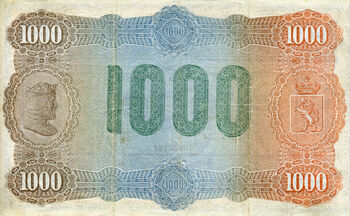
In the exhibition, you will find the first coin series with Norwegian kroner. You can also see the first 1,000-krone note from 1890 – the most valuable Norwegian banknote that has ever existed. When it was released, the Norwegian currency was linked to the gold standard, and with this banknote, you could purchase nearly half a kilogram of gold!

The front of the thousand-kroner note features King Oscar II in Swedish naval uniform and the city coats of arms of Norway's bishoprics.
Photo: Norges Bank

The back of the thousand-kroner note features a Viking and the national coat of arms of Norway. A watermark and colors that blend into each other were intended to prevent counterfeiting.
Photo: Norges Bank

Highs and Lows Over 150 Years
Throughout its 150-year history, the Norwegian krone has survived many dramatic periods. It has endured several wars and participated in various economic upturns and downturns. Along the way, the currency has been linked to Danish and Swedish kroner and the gold standard. Today, the value of the Norwegian krone is tied to the credibility and assets of the Norwegian state.
The King's Coins and the State's Banknotes
The designs on the Norwegian coins and banknotes tell an important story about the individuals, activities, and objects that have been significant to the nation-building of Norway over the past 150 years.
Ever since the Viking Age, the right to mint coins has been a royal privilege, a regale. The coins feature the king's portrait. They are also adorned with symbols and inscriptions that legitimize the king's power, such as the national lion and the motto "Alt for Norge," which Håkon VII chose in 1905. "Alt for Norge" can be translated to "All for Norway", it is the national motto of Norway and reflects the king's dedication to the nation. King Olav and King Harald have continued this tradition.
The banknotes have not been linked to the king, but to the Norwegian state. On these banknotes, we find individuals, cultural heritage, and natural resources that have shaped Norway, from the explorer and humanitarian Fridtjof Nansen and the Nobel Prize-winning author Sigrid Undset to the sea, the cod, and the Oseberg Ship, Norway's cultural treasure from the Viking Age. The sea has been vital for Norway’s economy and identity, providing access to trade routes and abundant fishing resources. Cod, in particular, has historically been one of the country's most important fish species, supporting the fishing industry and shaping coastal communities. War and weapons have not been represented on the banknotes.
Tomorrow's Currency
In 1983, 85 percent of all transactions in Norway were conducted using cash. Forty years later, that proportion has declined to 3 percent. Norway is one of the societies in the world with the highest usage of digital payment services. The government aspires to make Norway the most digitally advanced nation in the world by 2030.
Norges Bank, the central bank of Norway, is currently investigating whether to issue digital central bank currency. The Norwegian krone would then become a purely digital currency that meets the requirements for traceability and efficiency in an increasingly digital world order. How a future digital krone will take shape is still uncertain. At the same time, state currencies are facing growing competition from private cryptocurrencies like Bitcoin.
Will digital money completely replace coins and banknotes in the future?
Exhibition credits
The exhibition’s project group consists of museum staff.
- Project owner: Toril Rokseth
- Curator: Svein Gullbekk
- Project leader: Martin Hager-Saltnes
- Education and public outreach: Martin Hager-Saltnes
- Graphic design: Johnny Kreutz
- Exhibition design: Eili Lindøe
- Conservation: Mai-Britt Andersen Kleiven, Line C. Petzold
- Collections manager: Anette Sættem
- Photo: Lill-Ann Chepstow-Lusty, Thorleif Aass Kristiansen
- Communications team: Øivind Gulliksen, Tea Kristiansen, Ida Marie Bjørknes Gaarder
- Exhibition technician: Hugo Strand












