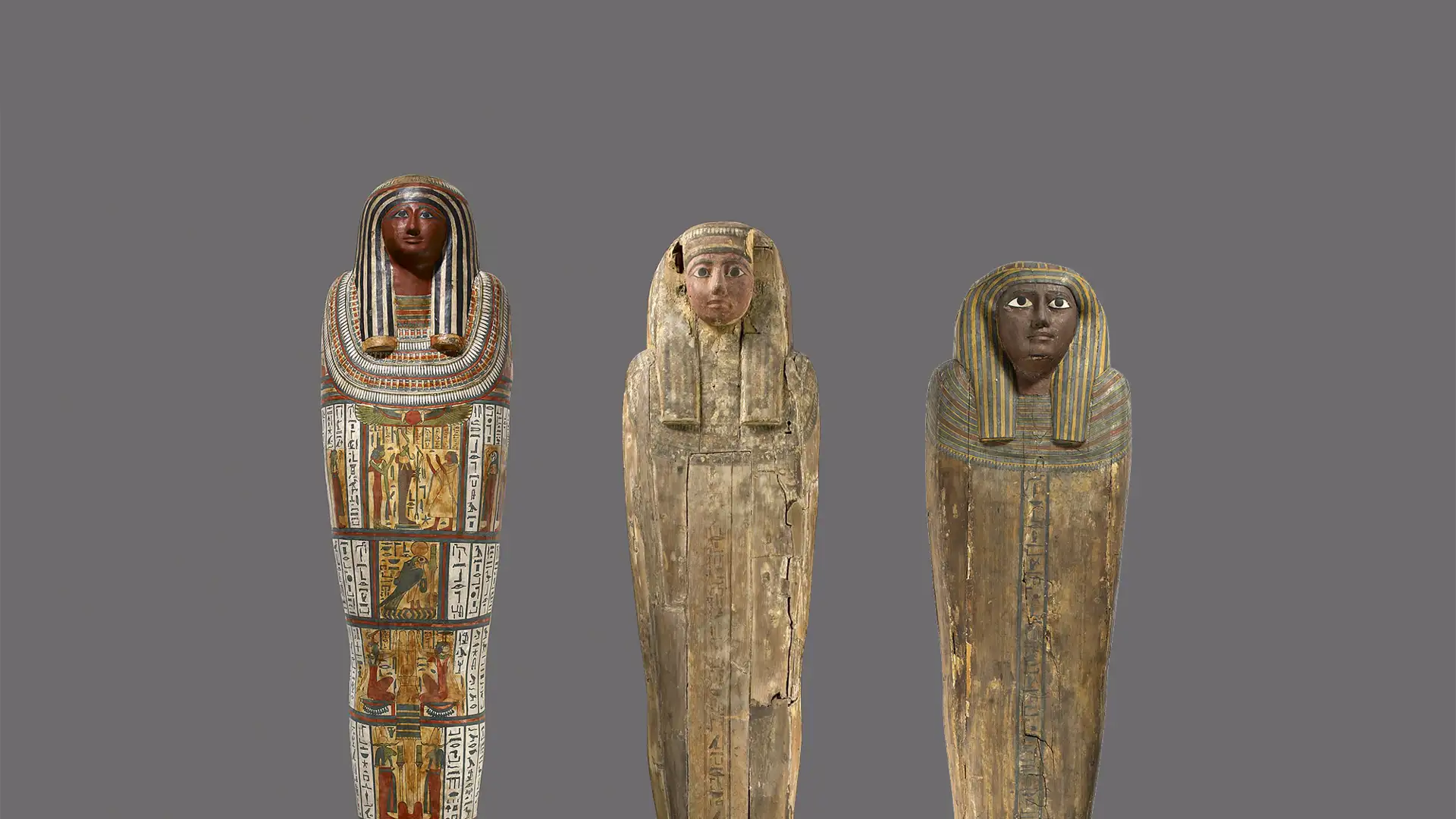
Together with her partner Padiamenet and their son Osirmose, the Egyptian family lived their lives during the 25th Dynasty (664–525 BCE) in Thebes, present-day Luxor. Dismutenibtes was a housewife, while her husband and son worked as chief doorkeepers for the temple dedicated to the sun god Ra. After their deaths, they were all mummified and probably buried in a shared family tomb, which was common at the time. Today, their mummies belong to different museum collections in Europe.
Why and how were they separated? To find the answer, we must fast-forward to the period after the Napoleonic Wars, which ended in 1815. At that time, a number of people, often merchants, were motivated to start their own antiquities businesses in Egypt because of a growing European market for ancient Egyptian objects. Many of these merchants acquired large collections, which they then sold to the highest bidder. Giovanni Anastasi (1770–1860) was one of those who seized this opportunity to make a lot of money. He was later appointed by Norway–Sweden as consul general in Alexandria in 1824.
Anastasi hired a number of agents who were sent to both Upper and Lower Egypt to excavate historical objects. He did not participate in the excavations himself, but funded them and collected the objects that were discovered. These excavations took place at a time when detailed, careful excavation methods were not yet as developed as they are today. As a result, detailed documentation of where objects were found is often lacking from this period.
New clues after almost 200 years
Because of the limited documentation, it has long been a mystery when the excavation of the mummy family Dismutenibtes, Padiamenet, and Osirmose took place. New clues, however, suggest that their burial chamber was discovered, opened, and excavated in the 1820s. These clues come from a series of letters between Anastasi and his chief agent Piccinini for the Theban Necropolis. The letters date up to New Year 1830, after Piccinini’s death. Piccinini can therefore only have excavated the three mummies in the 1820s, while he was still active. We do not know whether it was Anastasi himself or Piccinini who decided to separate the mummy family, but we do know that the mummies ultimately ended up in three different collections. Nevertheless, there are some theories that may explain what happened.
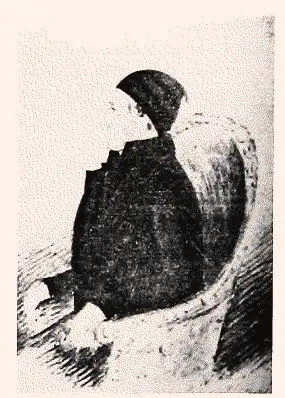
Since Anastasi seldom took part in the excavations, he may have been unaware that the mummies came from the same tomb and that they were a family. On mummy coffins, only the names of the deceased’s parents are inscribed, not those of partners or children, and so in this case only the son Osirmose’s coffin reveals the family connection. In any case, hieroglyphs were still a great mystery at the time. It was only a few years later, in 1828, that the Frenchman Champollion finally managed to unlock the secret of the Egyptian hieroglyphs, making it possible to read them for the first time.
For the merchant Anastasi, the family connection may not have been the most important factor. His primary aim was likely to sell the collections to major European institutions and private collectors. He sold three large collections comprising nearly 2,000 objects, but he also gave some items as gifts to various nations, institutions, and private individuals in order to establish or maintain good relations. We know that Dismutenibtes’ mummy was given as a gift to the Royal Frederick University in 1838, which today is the University of Oslo. Padiamenet was sold as part of Anastasi’s second collection to the British Museum, and Osirmose was sold at auction in Belgium as part of his third collection.
As a result, Anastasi sent the mummies on their own unique journeys, perhaps unknowingly separating them. Their connection was forgotten for almost 200 years, until the family relationship was rediscovered in 2006.
The exhibition MUMMY at the Historical Museum is the first exhibition to shed light on this connection and to highlight a rarely discussed question: where is Dismutenibtes' family, and why are they not together? In the exhibition, the connection between Dismutenibtes, Padiamenet, and Osirmose is made clear in large lettering behind her display case.
Photo credits
Top image, from left: The Trustees of the British Museum. Middle: Historical Museum, University of Oslo. Left: The Royal Museums of Art and History, Belgium.












