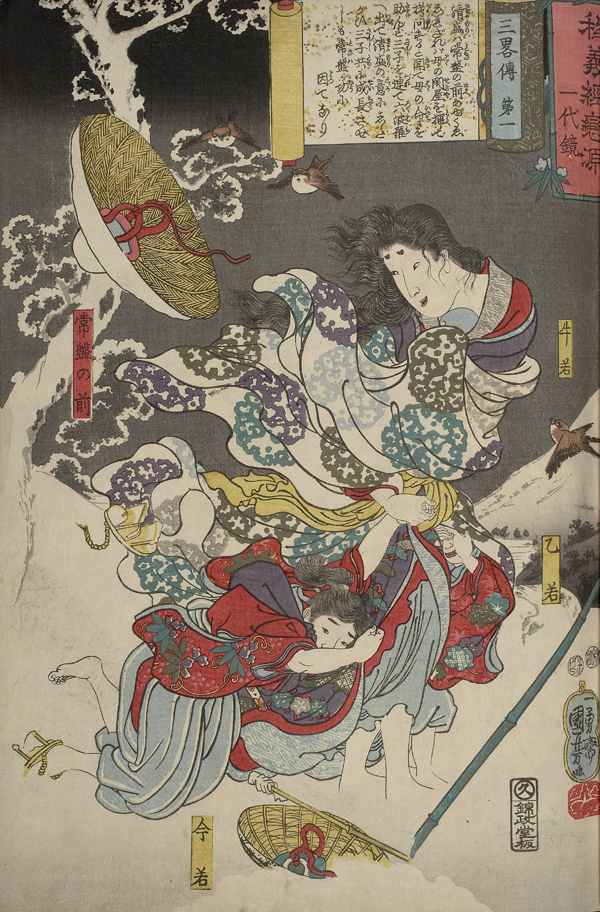
- Series: “Mirrors on the Love Life of Minamoto Yoshitsune.
- The Secrets of Strategy Chapter One”
- Hodo Yoshitsune koi no Minamoto ichidai kagami Sanryakuden dai ichi
- 程義經戀の源一代鏡 三略傳 第一
- 1848-53
- Signature: Ichiyûsai Kuniyoshi ga 一勇斎国芳画
- Marks: censors’ seals (Mera, Murata), artist’s seal (Yoshikiri)
- Publisher: Ibaya Kyûbei 伊場屋久兵衛 (Kinseidô; act. mid-19th c)
- Format: vertical large-size print (ôban tate-e) bound as a book
- Medium: multicolor woodblock print (nishiki-e); ink and color on pap
The shogunate censored art, not least because they feared it was moving beyond the bounds of propriety. Reforms in 1787-83 and again in the 1840s banned ukiyo-e artists from depicting real current events or types and characters from the world of prostitution and kabuki plays.
Characteristically, the tenet that gained moral ground was not the Buddhist notion of fleeting life, but rather – in an unstable political situation within the country – a Confucianism which instilled loyalty and obedience. The ukiyo-e masters responded by recasting their subjects as figures from well-known epics of the past.
But even so, the shôgun could never be sure whether a vile portrayal of a historical person might actually be a portrayal of himself. Allegory, humor, and irony were the true ingredients of these portrayals. Yet the ukiyo-e masters’ depictions were not entirely subversive. For some masters historical characters became paragons of Confucian virtue.
One figure which the Japanese at the time very much appreciated is Lady Tokiwa 1123 – c 1180, mother of the first shôgun, Yoshitsune. During the 1160 Heiji Rebellion, she was captured by the enemy clan, Taira, and held hostage. Kuniyoshi shows her fleeing through the snow with her children under the folds of her kimono.
Thus, with eyes trained on the present, viewers focused on women dedicated to pleasure, but when looking at the past, they focused on women dedicated to great self-sacrifice. In 1840-41, Kuniyoshi produced a series with the telling title: "Stories of Wise Women and Faithful Wives" (Kenjo reppuden 賢女烈婦傳).
The son of a silk-dyer, Kuniyoshi was but 12 years old when he became an apprentice in the Utagawa School. As a mature, independent artist, he struggled to make a living, but eventually gained acclaim and success through creating a series on the theme of legendary warriors, both male and female. His name is closely associated with warriors for he produced 370 triptychs and diptychs on the theme. But Kuniyoshi is also well-known for his prints of animals and plants.
His use of satire and irony, and his attempt to avoid the ban on portraying kabuki stage characters by replacing them with felines, brought him into conflict with the shogunate in 1843. He was reprimanded and his works confiscated.












