Utagawa Hiroshige 歌川広重 (1797-1858)
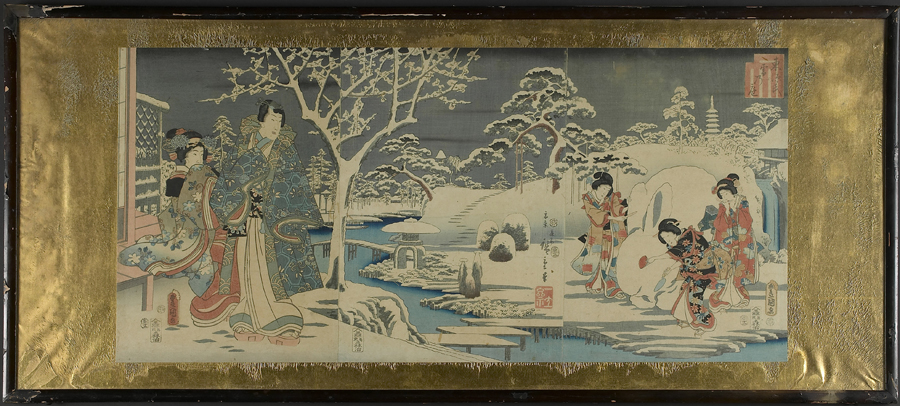
- 1854
- Signatures: Toyokuni ga 豊国画, Hiroshige ga 廣重画
- Marks: censor's seal (aratame), date seal, publisher's seal, Hiroshige’s seal (Ichiryûsai)
- Publisher: Moriya Jihei 森屋治兵衛 (active 1797–1840)
- Format: triptych, vertical large-size print (ôban tate-e)
- Medium: multicolor woodblock print (nishiki-e); ink and colors on paper
This triptych, made by Hirsohige and Kunisada in collaboration, is an example of a present-day scene in the guise of the past. The setting, architecture and clothing are late Edo (mid-19th century), but the story dates back several hundred years.
What is considered the world’s first psychological novel – The Tale of Genji – was written by Lady Murasaki, an aristocrat who lived in the early 11th century. The main character, Prince Genji, is shown in this triptych with the woman he loves most, also called Murasaki. The lives of the main characters are the source for the narrative. As if underscoring the evanescence of their lives in the mode of unfinished allusion, the book ends in mid-sentence.
The idea of a “floating world” and the finitude of sensual pleasures stem from Buddhism. But this did not prevent poetic and visual artistry from amplifying these aspects rather than the orthodox idea of chastity exemplified by the monk or nun.
The scene of maids fixing an eye on a “snow rabbit” (yuki-usagi) may refer to an ancient story about the moon god (Tsuki-yomi). He was born from an eye. In a more popular version – especially among children – a spirit of the moon emerges when it is full: as a rabbit pounding a circular rice cake.
Utagawa Kunisada 歌川国貞 (1786-1865)

- 1854
- Signatures: Toyokuni ga 豊国画, Hiroshige ga 廣重画
- Marks: censor's seal (aratame), date seal, publisher's seal, carver’s seal (Ichiryûsai)
- Publisher: Moriya Jihei 森屋治兵衛 (active 1797–1840)
- Format: triptych, vertical large-size print (ôban tate-e)
- Medium: multicolor woodblock print (nishiki-e); ink and colors on paper
Landscape portrayal allows the expression of the cyclical nature of things, as in the title of this series: snow, moon, flowers. The flowers are spring cherry blossoms and the moon is autumnal.
Here Kunisada’s attention has drifted back to an 11th century Japanese novel about the love-life of Prince Genji. But the wintry scene is from the Edo Period (1603-1868) and a Yoshiwara brothel: a customer is welcomed at the gate.
Kunisada’s father ran a ferry service, but his obvious talent as a visual artist enabled him to become a member of the Utagawa house of woodblock printing at the age of 14. By the end of his life, he was the most prolific among the ukiyo-e masters, with figures mostly from the world of the kabuki play.
The themes of his printed series also include landscape and female beauty, and there is even an erotic version of the Tale of Genji. Equally unconventional was his depiction of apparitions.
A Floating World is a transient world. In ukiyo-e we witness a floating world in the cityscapes. The bijinga –“beautiful person” pictures – showed the prime of beauty (female as well as male), as fragile as cherry blossoms. Snow-moon-flower appears as an impression that to the ukiyo-e artist condenses into a single word, setsugekka. Its allusion to femaleness can be heightened by an additional use of parody (mitate-e).
Ukiyo-e artists made compositions rather than depictions of human figures and landscapes. This might be said to be a Buddhist endeavor: to emphasize balance rather than depict a confusing and perhaps disturbing totality.
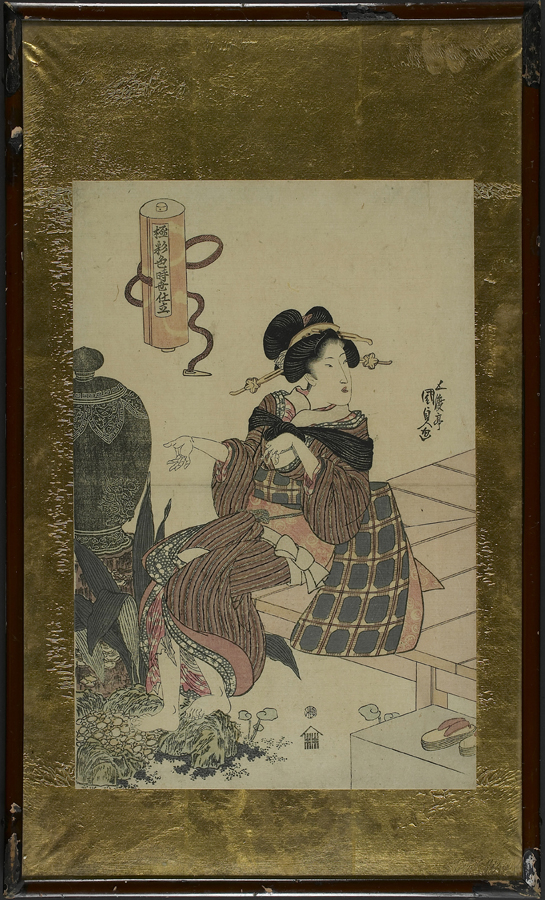
- Series: "Richly Colored Contemporary Fashions"
- Gokusaishiki imayô shitate 極彩色時世仕立
- 1828
- Signature: Gototei Kunisada ga 五渡亭国貞画
- Marks: censor's seal (kiwame), utgivers segl
- Publisher: Iseya Rihei 伊勢屋利兵衛 (Kinjudô; active c 1800s-40s)
- Format: vertical large-size print (ôban tate-e)
- Medium: multicolor woodblock print (nishiki-e); ink and colors on paper
The prolific Kunisada produced around 14,500 different designs. The bulk of this output was devoted to portraying kabuki actors and women of exceptional beauty. Far less emphasis was placed on landscapes or battle scenes.
He gave people what they wanted, fantasies we might say, by focusing on celebrity in the realms of theater and prostitution. But as with mass media today, he also added a sense of actuality and participation.
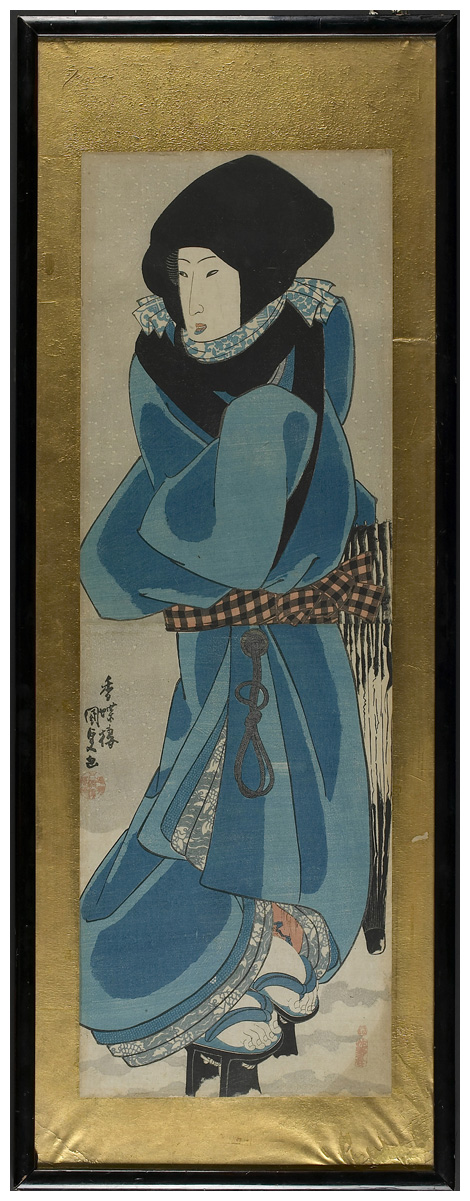
- 1830–44
- Signature: Kôchôrô Kunisada ga 香蝶楼 国貞画
- Publisher: Sanoya Kihei 佐野屋喜兵衛 (Sanoki, Kikakudô, active 1830s)
- Marks: artist’s red circular seal (gototei 五渡亭?), censor’s seal in red (kiwame), publisher’s seal
- Format: upright diptych print (kakemono-e)
- Medium: multicolor woodblock print (nishiki-e); ink and colors on paper
The woman depicted here by Kunisada steps through the snow on clogs but her feet are otherwise bare. Her sash is tied in front rather than in the back. She is a bijin. These two details reveal that she is a beautiful person from the pleasure quarters.












