Felipe wanted to learn lalava as a construction technique as well as a repertoire of designs.
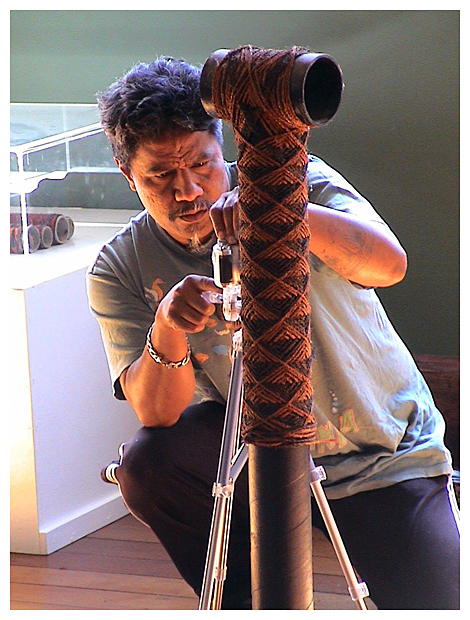
Felipe became intrigued by the characteristic patterns and variations created by this technique. Since then, his projects have explored these patterns by transferring them from their original use in boat and house construction to purely decorative objects made of yarn, wood, stone, steel or aluminum.
In his own words
My work is based on the ancient Pacific Island art form of lalava (lashing) that was used for joining and holding materials together. Meters of colored sennit were wound and tied so as to create distinct geometric patterns that were a well-established part of daily life. By changing the scale of lines I seek to intrigue the viewer with a manipulation of space and pattern, introducing them to a “first level” and creating a desire to discover more about what they see.












