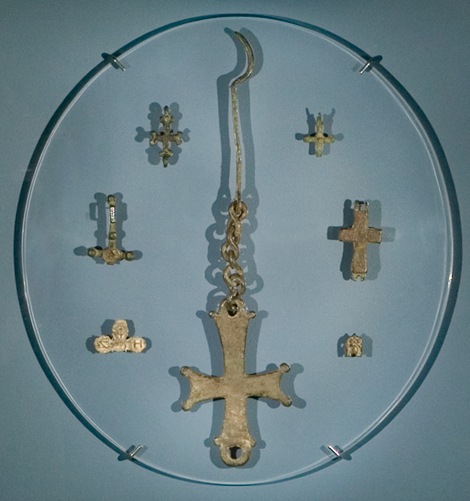
The first pilgrims
No other sentiment draws men to Jerusalem than the desire to see and touch the places where Christ was physically present, and to be able to say from our very own experience “we have gone into his tabernacle and adored the very places where his feet have stood
– Paulinus of Nola, late 4th century
The Emperor Constantine (312 – 337 AD) made it legal to be a Christian in the Roman Empire, and in the centuries that followed, a growing number of Christians set out as pilgrims to the Holy Land. Constantine also saw to the building of many churches in Jerusalem, the most famous being the Church of the Holy Sepulchre.
His mother, Helene, visited Jersusalem several times and contributed to its importance as a pilgrim destination. She also reportedly found the Holy Cross itself during the construction of the Church of the Holy Sepulchre.

In addition to Jerusalem, pilgrims visited other sites known from the life of Christ and the Bible: Bethlehem, where Jesus was born, Betania, with the grave of Lazarus, and the River Jordan, where Jesus was baptized.
Egeria and the oil lamps
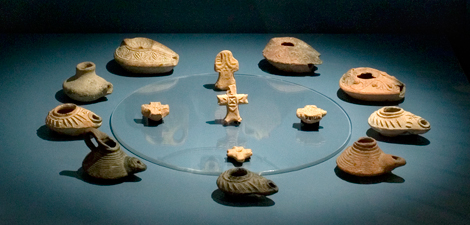
One of the first Christian pilgrims to visit Jerusalem was a woman named Egeria, who recorded her journey at the end of the 4th century. She writes that she is fortunate to have had the chance to visit the Holy Land and its famous sites.
She records every detail of her pilgrimage so that she can be the eyes and ears for “her sisters” back home in Gallia or Galicia (today’s France or northern Spain). Egeria tells of the church services in Jerusalem during Easter and describes the intense light from the many oil lamps in the churches.
Pilgrims’ flasks
Pilgrims often carried flasks or ampoules which could be filled with holy water from the River Jordan. Flasks were also filled with wine, as refreshment for thirsty pilgrims.
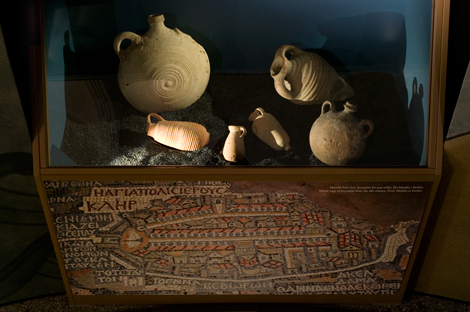
“Menas flasks”
These ampoules are called Menas flasks because they often show St. Menas flanked by two camels. A large number were also found by the well of St. Menas, near Alexandria in Egypt.
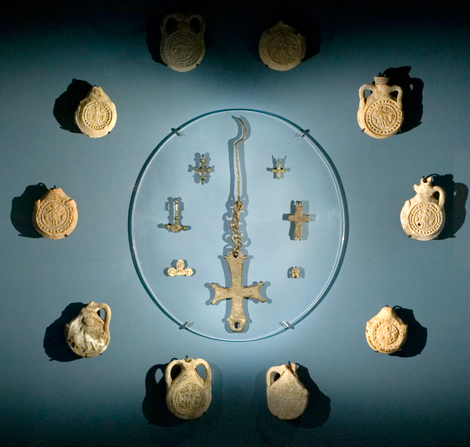
Amulets and crosses
Pilgrims also collected small amulets from the holy places they visited. These are called “eulogies” (in praise). These were usually made of clay and were decorated with portraits of saints or scenes from the Bible. It was important that they actually came from the holy place the pilgrim had visited.