Jerusalem
Jerusalem was the centre of the Medieval Christian universe and the main destination for pilgrims in the early Christian era. The numbers of pilgrims dwindled during the turbulent centuries following the “barbarian” invasions of the 5th century.
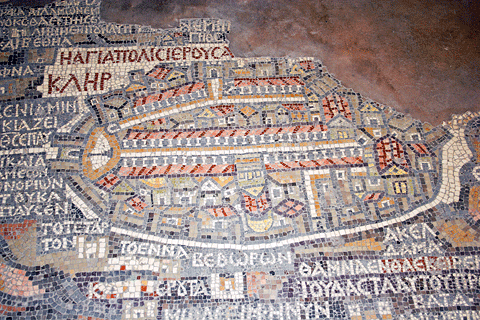
The conquest of Jerusalem by the Arabs in 623 and the spread of Islam also had an effect, but at no time was the city completely closed to Christian pilgrims.
The numbers of pilgrims from Europe increased in the 800’s and 900’s, but towards the end of the 10th century the trip became more difficult. Some Arab rulers persecuted Christian pilgrims in the Holy Land and the Turkish conquests in Asia Minor hindered overland travel.
When Pope Urban II called for the first Crusade in 1095 it was partly to reopen and secure the road to Jerusalem. For the next 200 years Jerusalem was a constant centre of conflict. When the crusaders held the city, pilgrims came, when the Muslims ruled, their numbers declined.
In 1291 the Europeans were finally driven from the city and the Crusades were over. Christian pilgrims continued to visit the Holy City, though from now on they usually came by sea.
Santiago de Compostela
James the Apostle was executed by King Herod in around 44 AD. According to legend, his body was taken by boat to the Roman province of Galicia, in the north-west corner of Spain. A small chapel was built over his grave.
Pilgrims first started visiting the shrine in greater numbers towards the end of the 10th century once travelling in western Europe had become less dangerous - viking raids were on the decline and the Muslim caliphate of Cordova, weaken by internal conflicts, was no longer a serious threat to Christian Spain. This meant that the roads from France through northern Spain were open and safe.
Work on the cathedral in Santiago de Compostela began in 1079, and extensions were added a number of times to accommodate the growing numbers of pilgrims who came to the shrine of St. James.
In 1189 the Pope declared Santiago de Compostela to be as holy as Rome and Jerusalem. It took over much of the “pilgrimage traffic” when Jerusalem came under Muslim rule during the Crusades.
The legend of Santiago, patron saint of Spain
Many of the legends of Santiago have a connection with Spain. After the death of Christ, James the Apostle (St. James = San Diego) went to Spain to spread Christ’s teachings. When he returned to Judaea, he was captured and put to death by King Herod. Under the cover of darkness, James’ disciples stole his body and set to sea in a small boat. Carried by the current, the boat eventually reached land at the Roman port of Iria Flava in the north-west corner of Spain. The body of St. James was secretly buried some miles from the coast.
Centuries later, in 813, a hermit had a vision while walking through the forest – he suddenly heard music and a brilliant star appeared in the sky. It cast its light on a field – Campus Stellae – and here the grave of St. James was found.
St. James
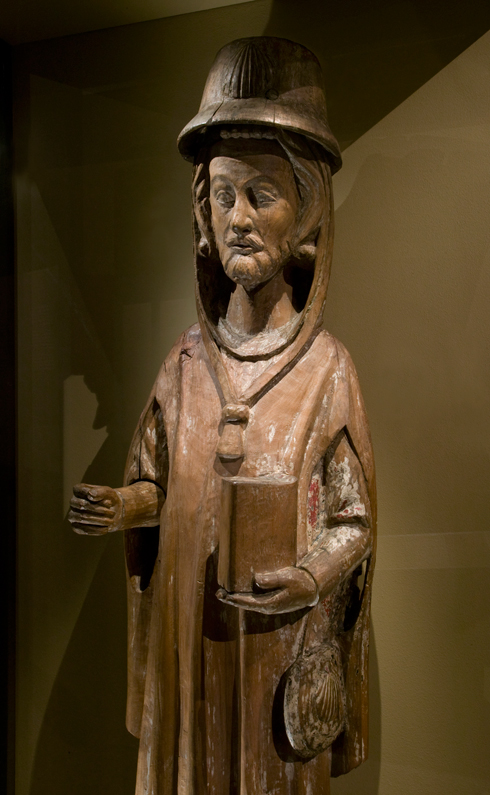
James the Apostle was the patron saint of medieval pilgrims. According to tradition, James received his staff from Christ himself. St. James is almost always depicted with a wide-brimmed hat and a scallop shell - his pilgrim’s badge.
His shrine in Santiago de Campostela in Spain was one of the most important destinations for pilgrims in the Middle Ages. The tradition nearly died out but has been revived in recent years..
Matamores – The Moor slayer
St. James the Moorslayer, one of the most valiant saints and knights the world ever had ... has been given by God to Spain for its patron and
– From Don Quixote, Cervantes (1547-1616)
St. James is also closely connected with the Christian struggle to end Muslim rule over southern Spain. In one story, St. James appears to Charlemagne in a vision. He tells the king of the Franks to follow the stars of the Milky Way to Galicia where he is to lead the battle against the Moors. Sometimes St. James takes part in la reconquista (the reconquest) himself, and is portrayed as a fearsome knight who cuts down his enemies with a sword..
St. James and the scallop shells
In the sea near Santiago there are certain fish with two shells, one on either side of their body… These shells the pilgrims of St. James gather up and sew onto their caps, carrying them home in triumph to their own people.
– Veneranda Dies, a 12th century pilgrim’s sermon .
Why is St. James portrayed with a scallop shell? A legend tells of a miracle that happened on board the small boat carrying the saint’s body to Spain. A horse belonging to one of the knights fell overboard and when it surfaced it was covered with scallop shells. St. James arose from his casket, rid the horse of the shells and saved its life.
Nidaros
Nidaros, (todays Trondheim) in Norway, was the most important pilgrim destination in northern Europe. Pilgrims came to Nidaros cathedral to visit the shrine of St. Olaf, or King Olaf Haraldson (995 to 1030). He fell at the Battle of Stiklestad in 1030 and was buried on the spot where the cathedral now stands.
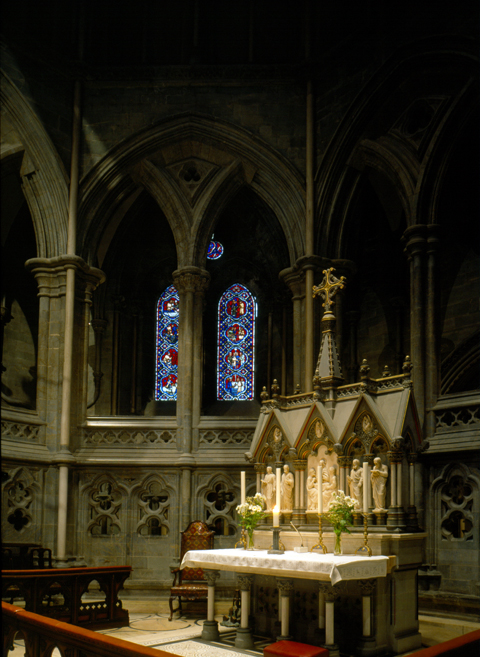
Olaf was made a saint in August 1031 after reports of signs and miracles at his grave - his body showed no sign of decay and his hair and nails continued to grow after his death. At his grave, bells would start ringing and candles would light by themselves.
King Olaf
When Olaf Haraldson grew up he was not tall, but middle-sized in height, although very thick, and of good strength. He had light brown hair, and a broad face, which was white and red.
Snorri Sturlson
Olaf Haraldson was born in 995, and was king of Norway from 1015 to 1028. He took part in his first Viking raid to England when he was twelve years old. His many trips abroad brought him in touch with Christianity and he was attracted to the ideal of the true Christian king. He became a Christian and was baptized in Rouen in 1014.
As king, he used his position to strengthen Christianity in Norway, where many were Christian in name, but still practiced the old beliefs. He was known for being ruthless when making his subjects toe the line. He forced his powerful rivals into submission, before he himself was killed by his opponents on the battlefield in 1030.
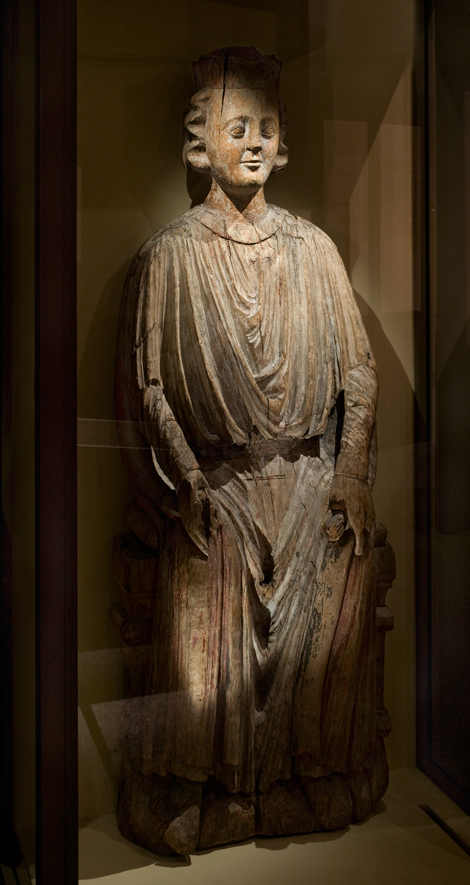
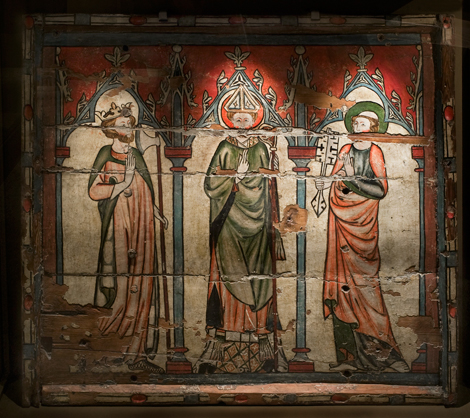
The Holy Cross from Borre, 1275 - 1300
The church in Borre in Vestfold is dedicated to both St. Olaf and St. Nicholas. Pilgrims came to the church to venerate the “Holy Cross”. In 1411, Queen Margrete I of Denmark-Norway sent three pilgrims to Borre to pray for her. They brought with them a gilt cup for the church’s altar.
Rome
After the death of Christ, his disciples went out to spread his teachings. The apostles Peter and Paul travelled to Rome but were put to death by Emperor Nero. Peter is regarded as the first Pope, and St. Peter’s church is said to have been erected over his gave.
The persecution of Christians continued in the centuries that followed and the catacombs of Rome became filled with graves of Christian martyrs.
When Christianity was legalized, these bodies and body parts were moved to newly-built churches and became relics.
The presence of the Pope, St. Peter’s and the many churches of the martyrs made Rome one of the major pilgrim destinations in medieval Christendom. Rome was also a natural stopover for pilgrims on the way to or from Jerusalem.
Rome – a city of saints and sinners
God has granted me the privilege of praying at the shrines of the blessed Peter and Paul and in every sanctuary within the city of Rome. And this privilege I have sought because wise men have told me that the apostle Peter has received from God the power of binding and loosing and carries the keys of Paradise.
– King Canute, 1027
Rome was the city of sinners. It was to Rome convicts and criminals came from all over Christendom in hope of gaining forgiveness for their sins (absolution). They came to Rome because only the Pope could grant absolution for the gravest sins.
The Year of the Jubilee
Every hundreth year is held the Roman Jubilee.
To he who is penitent all crimes are forgiven.
From a missive under Boniface VIII, Pope from 1294-1303
The Jubilee was originally a Jewish tradition. Every 50th year, an amnesty was declared -prisoners were set free and people settled their disputes and made up for past transgressions.
In the Middle Ages, the Jubilee came to mean the years the Pope gave “general amnesty” to all who repented their sins and came to Rome.
Coins of Popes and pilgrims
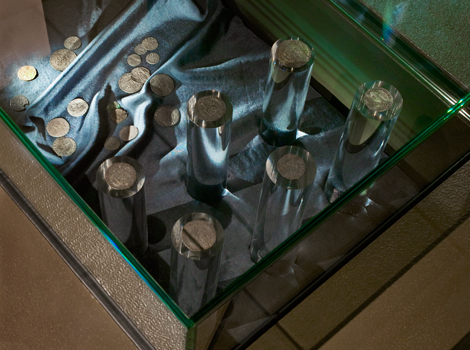
To begin with, the Jubilee was only meant to be celebrated at the turn of each century, but it soon became so popular that it was held every 25 years. These coins were minted by Popes who proclaimed Jubilee years in their time in office.
-
Nicholas V (1447-1455)
-
Sixtus IV (1471-1484)
-
Alexander VI (1492-1503)
-
Clemens VII (1523-1534)
-
Julius III (1550-1555)
Petty cash
From the offerings of the pilgrims the Church gained great treasures and all the Romans were much enriched. Ptolemy of Lucca
Although Rome benefited from the many pilgrims who came to the Jubilee, individual offerings were usually fairly small. These coins from the 14th century are from England, France, Italy, Germany, Spain, Denmark, Sweden and Norway.