Saints
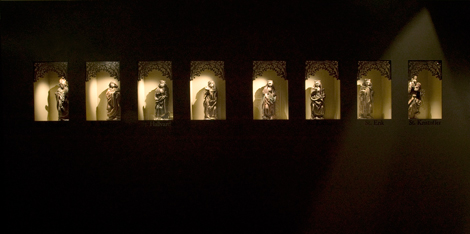
Saints were ordinary people - men and women, young and old - who were regarded as holy because of their piety, compassion and strong Christian faith. According to Catholic belief, saints act as intermediaries between people and God. They aid and protect and can intervene on people’s behalf.
Every saint has a Saint’s Day and a saint’s calendar shows the day each saint is celebrated. All the saints are celebrated on the 1st of November, All Saints Day.
Saints´ graves
Many saints died as martyrs for their faith. Already in early Christian times people made journeys to martyrs’ graves to mark the day of their death. This tradition of pilgrimage grew and came to include the graves of other holy men and women.
God’s presence was thought to be especially strong at the graves of saints. Because of their holiness and good works, saints could intervene on behalf of those who came to visit their graves. It was here that miracles happened and pilgrims received forgiveness for their sins.
Holy places vied with each other to have the best reputation for redemption, cures and miracles. “The pilgrim industry” was of great economic importance and the more pilgrims a shrine could attract, the greater its revenue from offerings and the sale of relics, guide books, pilgrim’s badges and other souvenirs.
Altar piece from Onsøy
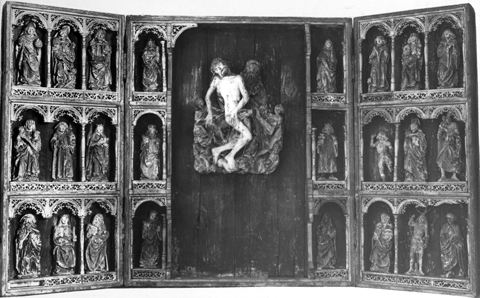
The eight saints displayed here come from a large wooden altar piece from Onsøy church in Østfold. It was probably carved in a northern German workshop around 1520. The altar piece may once have belonged to a nunnery in Oslo, but after the Reformation, it was taken to Onsøy church in the 1590’s.
The altar piece contains 24 figures in all. We have chosen eight saints that are particularly connected to pilgrim’s and pilgrimages: St. Brigid, St. Sunniva, St.Erik, St. Hallvard, St. Magnus, St Nicholas, St Christopher, and St. Catherine. Two more figures appear in the exhibition – St. James and St. George.
Eight stories about saints
St. Sunniva
Saint´s Day: 8th July
Major shrine: Selja, Norway
Patron saint: West Norway, Bergen, sea-travellers
Attributes: She holds a piece of cliff in her right hand

St. Sunniva is Norway’s only female saint. According to legend, she was an Irish princess who fled from Ireland in the 10th century along with her brother, Alban, and small party of Christians. They were probably fleeing from the Vikings. They set out in three small skin boats without oars or sails, and let God decide where they would reach land.
The voyage took them to the island of Selja, of the northwestern coast of Norway. Earl Håkon heard that strangers had landed on the island and went to see who they were. In fear, Sunniva and her party hid in a cave in the cliffs. They prayed to God to hide them so that no man should kill them. Suddenly, part of the cliff collapsed, closing the entrance to the cave. When the earl and his men reached the island, there was no one to be found.
Later, in 966, a wondrous column of light appeared over the site and bodies of Sunniva and her party were found intact. King Olaf Trygvasson built a church near the cave in memory of Sunniva, and Selja became a place of pilgrimage. Around 1100, Benedictine monks moved to the island and founded Selje Monastery, dedicated to Sunniva’s brother Alban. Her shrine was later moved to Christ Church in Bergen.
St. Birgitta of Vadstena
Saint’s Day: 23rd July, 8th October
Major shrine: Vadstena, Sweden
Patron saint: Sweden, widows
Attributes: An open book, a staff

Birgitta Birgersdatter (1303 – 1373) was herself a diligent pilgrim and journeyed to the four major pilgrim destinations; Santiago de Campostela, Rome, Jersusalem and Nidaros. Birgitta grew up in a nobel family in Uppland in Sweden and, even as a child, experienced visions and revelations. She later married and bore eight children. She went on a pilgrimage to Santiago de Compostela with her husband, and when he died shortly afterwards, she founded the Bridgettine order in Vadstena in Sweden.
St. Catherine of Alexandria
Saint’s Day: 25th November
Major shrine: St. Catherine’s monastery, Mont Sinai, Egypt
Patron saint: Wheelwrights, potters, spinners, lawyers and young women
Attributes: A wheel, sword, dove, book, bridal veil
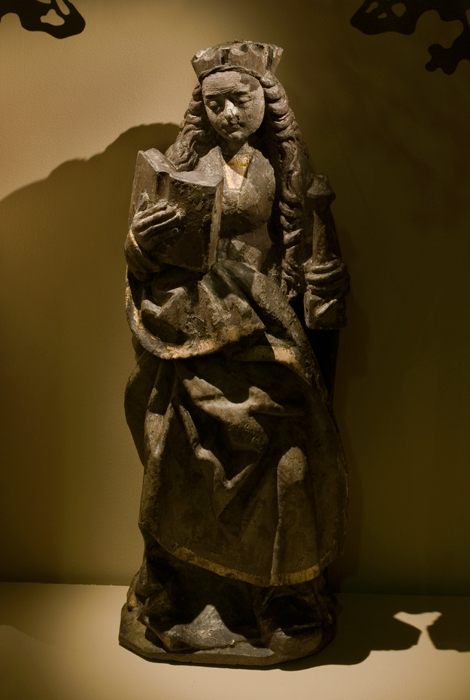
According to legend, Catherine was born in Alexandria in Egypt, and came from a noble family. She lived when Maxentius (303 – 318 AD) was emperor of Rome. He was zealously opposed to the worship of “false gods” and persecuted Christians harshly. Catherine was a brave and intelligent young woman, and was herself a convert to Christianity. She challenged the emperor to a debate, hoping to convince him that he treated Christians wrongly. Catherine argued well and she won the debate. Those who heard her, including the Empress, went over to the new faith. The emperor, however, was enraged.
Another story tells that Catherine was put in jail because she refused the emperor’s proposal of marriage. In jail, she was helped by a dove that brought her food. The emperor then had her tied to four wheels with rotating blades meant to cut her to pieces, but she was saved by an angel who came down from heaven and destroyed the instrument of torture. In the end, she was beheaded with a sword. The angels brought her body to Mont Sinai, where the emperor Justinian later founded a monastery in the 6th century. Health-bringing oil is said to drip from her grave. The monastery is still a place of pilgrimage.
St. Nicholas
Major shrine: Bari, Italy
Patron saint: Children, seamen, prostitutes, pawnbrokers
Attributes: Mitre (bishop’s hat), three gold balls, three children in a barrel
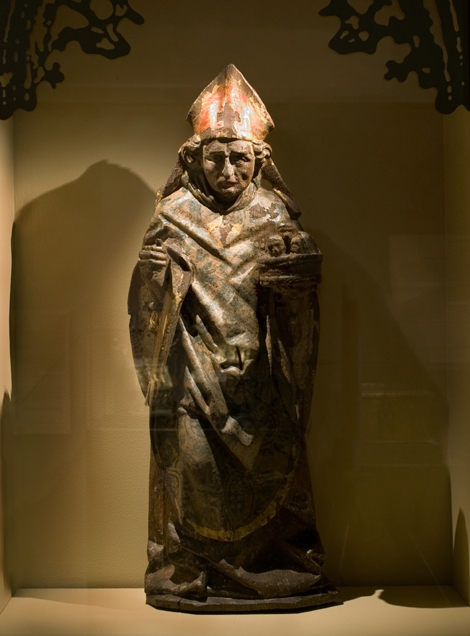
The story of St. Nicholas begins in Asia Minor around 270 AD. Nicholas was the bishop of Myra, today’s Kale in Antalya in Turkey. He was known to be a pious and generous man who could perform miracles. Once on a pilgrimage to Jerusalem he miraculously calmed a storm at sea.
Nicholas died in Myra on the 6th of December in around 350 AD, but a cult devoted to him first developed some 200 years later. Stories of miracles spread far and wide and pilgrims flocked to his shrine in Myra. In 1071, the town was attacked by the Turks. In response, seamen and merchants from Bari in Italy sailed to Myra and rescued Nicholas’ remains.
From St. Nikcholas to Santa Claus
St. Nicholas is the patron saint of children, as two legends illustrate. One is the story of how St. Nicholas saved three poor young maidens from a life of prostitution. Under the cover of night he threw three purses of gold coins through the girls’ window so that they could afford to marry. This kind act was the start of the tradition of giving gifts to child-ren on the 6th of December, and later at Christmas.
Another legend tells of how St. Nicholas saved three young men from death. The boys had stopped for the night at an inn. The innkeeper, needing meat for a stew, murdered the boys, cut them into small pieces and placed them in a barrel of brine. When Nicholas saw what had happened he made the sign of the cross, and all the pieces became whole again, and the children came back to life.
St. Christopher
Saint’s Day: 25th July
Patron saint: Travellers, drivers, surfers
Attributes: He carries the Christ child on his shoulder, a flowering staff
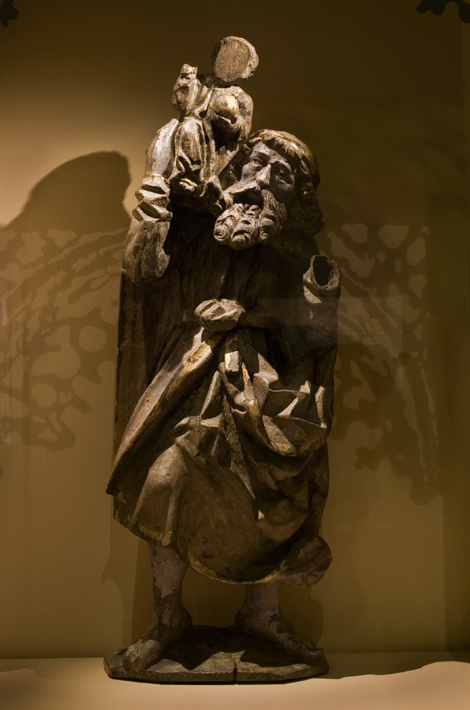
St. Christopher is the patron saint of travellers. He supposedly lived in the 3rd century, but he is only known through legend. Christopher was a giant of a man who liked to fight and bully people. One day he had a vision of a cross, but did not know what it meant until he met a hermit who told him that Christ had died on a cross.
Christopher was deeply moved and vowed to become a better person and make up for all his bad deeds. He moved into a hut by the riverside and began helping people to cross by carrying them over to the other side.
One stormy night he was woken by a little boy who needed help. Christopher lifted him to his shoulders, grabbed his staff and entered the turbulent river. The boy seemed heavier than expected, but the giant carried on. At last they reached the other side. “Praise the Lord.” he said. “It feels as if I have carried the weight of the whole world on my shoulders” The child replied: “You had on your shoulders not only the whole world but him who made it. From now on you shall be called Christopher, he who carries Christ.” The boy, who was Christ, told Christopher to stick the staff in the ground before he went to sleep. When Christopher woke up the next morning, the staff had become a tree bearing flowers and fruit.
St. Erik
Saint’s Day: 18th May
Major shrine: Uppsala, Sweden
Patron saint: Sweden, Uppsala, Stockholm
Attributes: Three crowns

Erik Jedvardsson, or St. Erik, was king of Sweden in the 1150’s though he probably only ruled over part of the country. According to legend, he was a fervent champion of Christianity and led a crusade to Finland. Erik was murdered in Uppsala in 1160 and was regarded as a martyr. A spring miraculously burst forth at the place where he fell, and from the 1200’s there are a number of stories about other miracles. His son Knut Eriksson campaigned for his sainthood but he was never officially canonized by the Pope.
St. Hallvard
Saint’s Day: 15th May
Major shrine: St. Hallvard’s Cathedral, Oslo
Patron saint: Oslo
Attributes: He holds a millstone

Hallvard Vebjørnsson was born around 1020. His mother was St. Olaf’s cousin and Hallvard was brought up a Christian. His legend begins on a day in May 1043 when young Hallvard was about to cross Drammen’s Fjord in a boat. There came a young woman, probably a thrall, and asked for Hallvard’s help. She was fleeing from two men who accused her of theft and she feared for her life. Hallvard believed in her innocence and took her away in the boat. But the men soon caught up with them. They accused Hallvard of aiding a thief and a liar, and when Hallvard defended the woman, the men flew in a rage. One of them took out his bow and shot Hallvard in the neck. Then they slew the woman and rowed ashore with the bodies. They buried the woman on the shore, but when they tied a millstone around Hallvard’s neck and dropped him into the fjord, he floated up again and would not sink.
He was first buried in a little chapel where a heavenly light was said to shine on his grave, and a sacred spring suddenly appeared on the shore. Soon other miracles were reported, and Hallvard was venerated as a martyr because he had died trying to defend an innocent person. In 1053 his remains were moved to the Church of St. Mary in Oslo. He lay in a beautiful casket, placed behind the high altar. The casket was later moved to St. Hallvard’s Cathedral when it was completed in 1130.
St. Magnus
Saint’s Day: 16th April
Major shrine: St. Magnus’ Cathedral, Kirkwell, Orkney
Patron saint: The Orkney Islands
Attributes: Sword (the weapon that killed him)
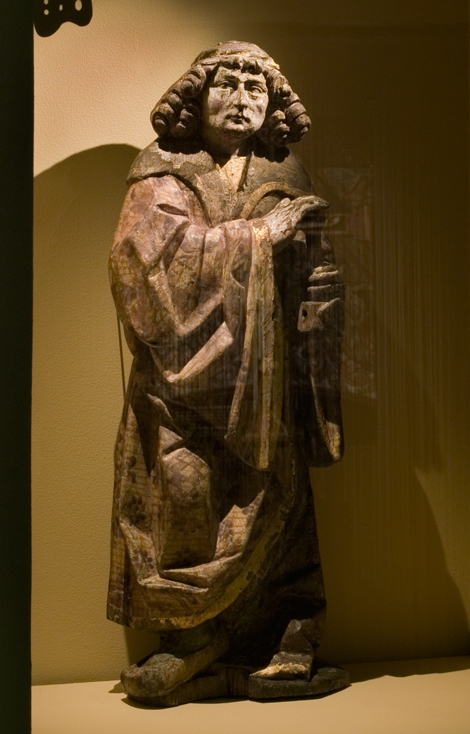
The story of Magnus Erlandsson centres on the power struggles and political intrigues in the Orkney Islands, Norway and Scotland at the turn of the 12th century. Magnus was born on the Orkneys in 1076. His father ruled over half the islands, his uncle over the other half - until the Norwegian king disposed them both. Magnus was taken prisoner, but escaped to Scotland.
When Magnus finally returned to Orkney to claim his father’s half of the islands, he found that his cousin, Håkon Pålsson, was ruling as earl of all of Orkney. At Easter 1115, Magnus and Håkon agreed to meet on the island of Egilsay to discuss a settlement. Each was supposed to bring a small entourage of men, but Håkon turned up with an army and eight war-ships.
Magnus refused to fight against such odds, and tried to make terms with Håkon. He offered to make a pilgrimage to Rome, or even Jerusalem, where he would visit all the holy places and do penance for both their sins. He also vowed never to return to the Orkneys. Håkon rejected the offer. Next Magnus said he was willing to be imprisoned for life – but again Håkon refused him. Magnus then told his cousin that he would rather be maimed or blinded than that Håkon should have his death on his conscience, and to this his cousin agreed.
But Håkon’s men were enraged - they did not want two earls on Orkney. They vowed they would kill one or the other, as long as only one earl remained. “Kill him, then”, was Håkon’s reply, “for I would rather rule over land and realm than die suddenly.”
After Magnus had prayed for his executioners and blessed their swords, he was killed by two blows to the forehead.
Relics
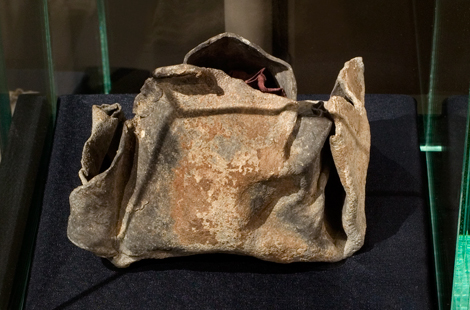
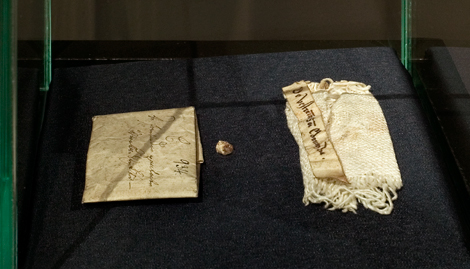
The physical remains of a holy person - their relics - were thought to have special powers to work miracles and wonders. The most powerful relics were those connected to Christ, the Virgin Mary and the Apostles.
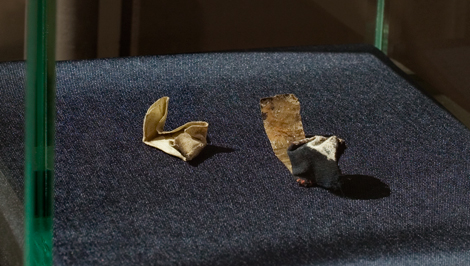
The bodies and bones of saints were much sought after, as were clothes they may have worn or objects they might have used or touched. Saint’s bodies were sometimes moved from place to place or taken apart and divided among several churches so that as many people as possible could benefit from the saint’s miraculous powers. The cult of relics was an important aspect of the pilgrimage. To be physically close to a relic, was also to be close to God.
Reliquaries
“For him a golden shrine is made,
For him whose heart was ne’er afraid,
Of mortal man - the holy king,
Whom the Lord God to heaven did bring.
From medieval Norway, we have several types of shrine or reliquary in which relics were kept. A saint’s shrine or casket was made to contain all or most of the saint’s remains and was often placed by the high altar in the church where the saint was venerated. St. Olaf’s shrine from Nidaros Cathedral no longer exists, but the skald Snorri Sturlson tells us that it was the shape and size of a coffin, with a lid like a raised roof and that it was adorned with precious stones, silver and gold.
Smaller reliquary chests were often shaped like buildings - usually a church - and could be adorned with precious stones and metals or enamel plaques.
“The Hundorp chest
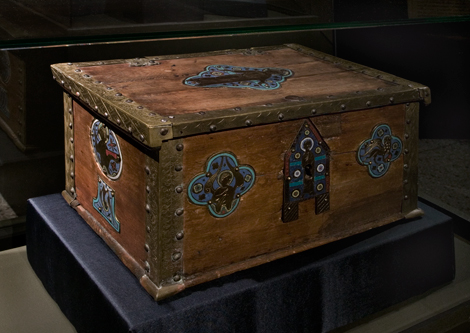
This pine chest has eleven enamel plaques that show Christ, saints and the symbols of the Evangelists. The wooden chest is not original and was probably made in Norway in the 18th century, but the colourful enamels were made in Limoges in France in the mid-13th century. The enamels were originally part of various church furnishings; the two gable-shaped plaques were once part of a reliquary chest, while the other nine plaques come from three different crosses. Hundorp, in the Gudbrandsdal Valley, lies along the main pilgrim route to Nidaros.
Hundorp, Sør-Fron, Oppland
Reliquary chest from St. Thomas’ church. Filefjell, Valdres, Oppland
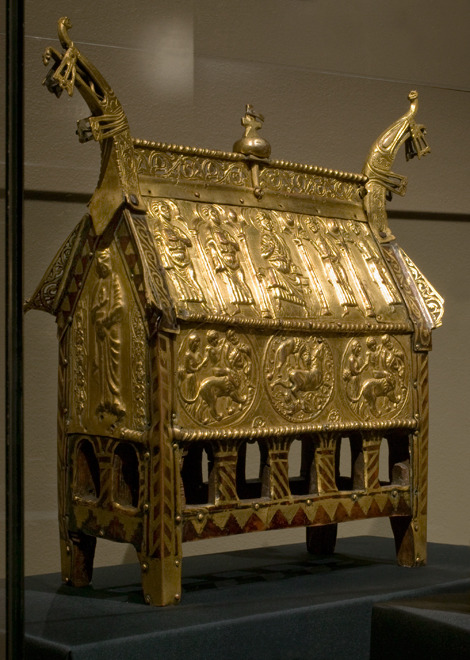
The medieval church of St. Thomas in the File Mountains no longer exists. It was probably a local shrine and place of pilgrimage, although we can no longer connect it with a particular pilgrimage tradition. Was the church dedicated to St. Thomas the Apostle or to St. Thomas Becket? Whose relics did it once contain?
The chest is made of oak with plates of gilded copper depicting scenes of Christ and the Apostles. It probably dates to the 13th century. Loan: Bergen Museum
Reliquary chest (reconstruction)
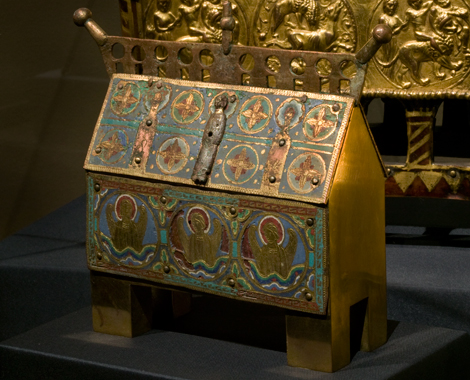
The chest has been put together from parts of four different enamel chests from the 13th century. The enamels are from Limoges in southern France and may well have been brought to Norway with pilgrims. The main pilgrim route to Santiago de Compostela ran through the town of Limoges, renowned for its enamel workshops.
The ”Thomas Becket chest”. Hedalen, Valdres, Oppland
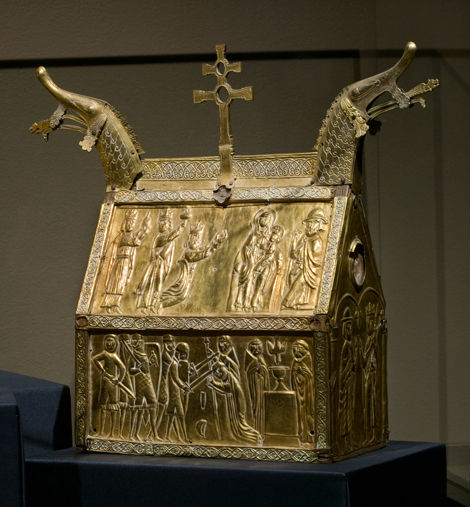
Canterbury in south-east England became a popular place of pilgrimage after archbishop Thomas Becket was murdered there by King Henry II’s men in 1170. A scene from the life and martyrdom of Thomas Becket can be seen on this reliquary chest from Hedalen church. Above is the Adoration of Christ, where St. James, wearing his characteristic hat, is seen to the right of Mary. The figures of St. Olaf and St. James are found on one of the gable-ends, St. Peter on the other. C 1250..
Loan: Hedalen stave church, Sør Aurdal church council
Reliquary crosses
Relics for more personal use became increasingly common. In the later Middle Ages, jewellery containing relics was especially popular. We have a number of reliquary crosses and medallions that are finely crafted and embellished.
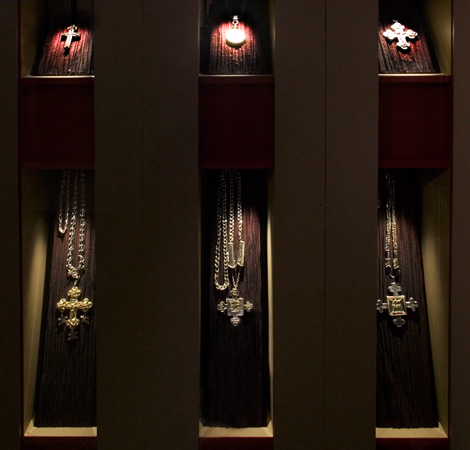
Above from left
- Reliquary cross contained a bone splinter. Storgaten, Tønsberg
- Reliquary medallion. Bø, Telemark
- Reliquary cross, 1400/1500’s. Drammen (?)
Below from left
- Reliquary cross, 1400/1500’s. Drammen (?)
- Reliquary cross and chain. Heddal church, Telemark
The sweating crucifix
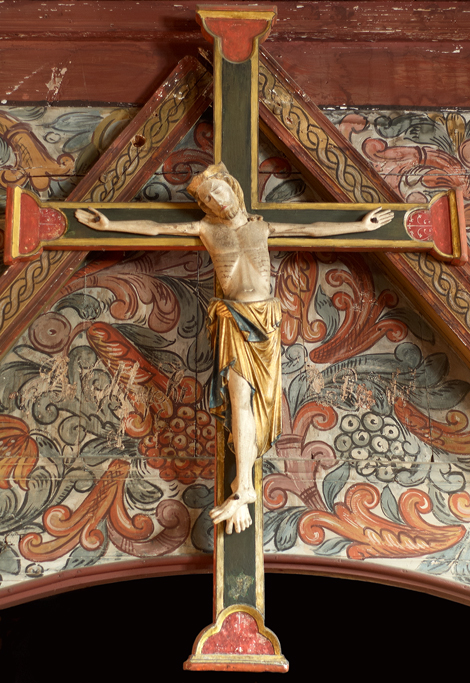
(Not translated:) Pilegrimene valfartet til Røldal for å besøke kirkens ”svettende” krusifiks. Valfartene til Røldal fortsatte fram til 1835. I de siste årene har pilegrimsvandringer til Røldal tatt seg opp igjen, men i moderne drakt.
Votive offerings – answers to a prayer
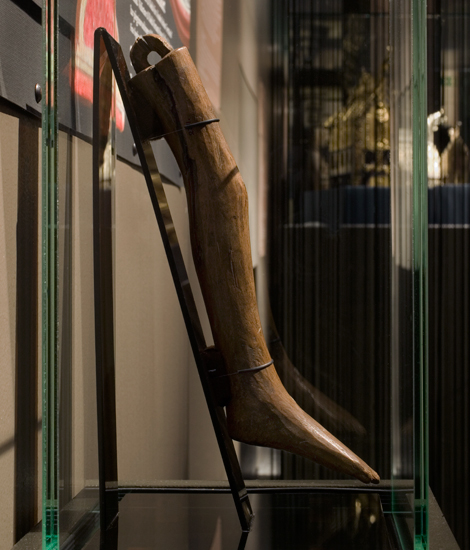
People who were sick or had other afflictions went on pilgrimages to be cured. If their prayers were answered, they could show their gratitude by giving gifts to the church. These sometimes took the form of votive-offerings, such as little models of the part of the body that had been cured – an eye, a heart or a leg.