The tomb
Construction of the tomb was started while the tomb owner was still in good health so that it would be ready on the day it was needed. Members of the class of officials would normally begin working on their tombs while still in their thirties, and this would be their main financial project the rest of their lives.
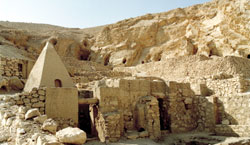
Nevertheless, most of the tombs are unfinished—not necessarily because the owner died early, but because people strived to make the tomb as big and elaborate as possible. If a tomb owner lived long enough to finish the tomb, expansions were started immediately. Powerful men on their way up the social ladder would often abandon work on one tomb and begin another, more prestigious tomb at another place.
The tombs consisted of a burial chamber, where the deceased was placed in a sarcophagus, and a mortuary temple where ceremonies on behalf of the dead person were performed. The burial chamber was often found underground, while the mortuary temple was above ground. The pyramids were built according to a similar principle, with the burial chamber and the actual pyramid situated in the desert, and a temple for the king’s death cult placed at the boundary between the desert and cultivated land.
The burial chamber was for the deceased, and the temple for the relatives. Here, the relatives could present offerings and read prayers for their ancestors. The burial chamber was often undecorated and contained only the sarcophagus and the items the deceased would need in the afterlife, for example the canopic jars and ushabtis.
The mortuary temple was usually richly decorated. The walls were often adorned with paintings and reliefs, often centered around the temple’s midpoint, the false door. The false door looked like a series of doorways placed inside one another, but there was no real opening in the wall behind. In front of the door was a sacrificial table where the living could present offerings and prayers to their dead relatives. This door functioned as a gate between the physical world and the spiritual world. It was thought that the souls of the dead could rise up from the underworld, represented by the burial chamber below, and partake of the life-giving «essence» of the offerings by passing through the gate.
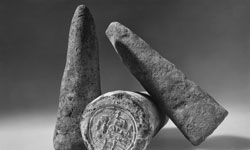
Outside the tombs in Thebes a number of so-called funerary cones have been discovered.5 These remarkable cones are about 15–25 cm high and made from fired clay. At the bottom, there is a circle in relief, with the name and title of the deceased written in hieroglyphs. This short text generally also contained a supplication to Osiris or Anubis. Studies of antique tomb paintings depicting temple facades have provided answers to how the cones were used. The pictures reveal a border of circles above the entrance to the mortuary temple. Researchers believe the border was made with funerary cones and that the deceased’s name and titles were stamped into the wet layer of plaster.
The funereal ritual and the cult of death
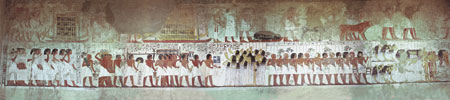
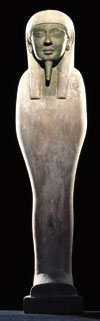
Photo: Eirik Irgens Johnsen
After the mummification was completed, it was time for the burial. The deceased was pulled on a sled followed by family and friends. This procession was a key part of the ritual. Mourners wailed and screamed, and rubbed sand in their hair. At the tomb, the human-shaped coffin was raised like a statue outside the burial chamber.
The Sem priest, often the eldest son of the deceased, approached, and the ritual of opening the mouth was performed. This ritual was to ensure that the soul could return to the body —the mummy— which was now a sacred sah and no longer an impure corpse. The coffin was then lowered into the burial chamber and sealed in the sarcophagus. Food offerings, such as bread and beer, were placed on the sacrificial table in front of the false door in the mortuary temple.
These offerings could also include linen and ointments so that the deceased could maintain his own mummy. The burning of incense was an important part of the ceremony. When incense is burned and loses its solid form, it dissipates into the air like a wafting breeze. This was a metaphor for death, when the soul leaves the body. The smoke has the same nature as the soul, and it was believed that the soul was especially appreciative of an incense offering. The ancient Egyptians believed in two parallel realities, one physical and one spiritual. Religion was their way of communicating with the spiritual world. The false door and incense burning are clear examples of this.
Communication between the dead and the living did not end at the funeral. Each family had to make sure that their dead always had fresh offerings on their sacrificial tables, and that their names were spoken so that the memory of the dead could be kept alive. The Egyptian calendar was filled with festivals honoring the many gods. During the festivals, their statues were removed from the temples and carried in a procession along fixed routes. Sometimes the procession traveled by boat across the river to the west bank, where the necropolis was located. The festival participants would sacrifice and pray to their dead, and ask the gods to protect the dead in the underworld. They could also ask the dead to help them solve earthly problems —for a particularly fine offering, naturally.
Myth reflected in ritual
There are obvious parallels between funereal practices and myth. It is clear that the dead wished to be identified with Osiris. The text on the coffins and the papyrus roles refers to the deceased as «an Osiris.» The anthropoid (human shaped) coffin represented not only a person, but also the god Osiris. The same applied to the mummy itself.
Dressing something in linen was a way of making it sacred. For example, the hieroglyph for «god» is an axe-shaped object carefully wrapped in linen. The ritual cleansing removed the impurities of the dead. Bandaging made the body divine. The royal wig, the crossed arms and the false beard on the coffin, as well as all the jewelry and aromatic oils on the mummy, were other ways of emphasizing the divine nature of the deceased.
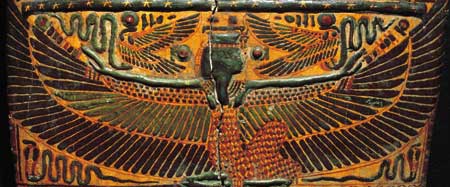
At the bottom of the coffin and in the center of the lid we often find pictures of Nut, goddess of the sky and mother of Osiris. The images of Nut encircle the entire coffin, and the coffin probably represents the womb of the goddess. Being buried in the womb of the goddess implied being reborn in the underworld as Osiris. The sun myths also contain the idea that the sun god’s journey through the underworld occurs through the body of Nut. Thus the deceased is identified with the sun god because both are reborn through Nut. Osiris was also thought to be the mummy of the sun god. In the same way that the soul of the dead had to return to the body every night to be revived for a new day, the sun god had to be united with Osiris every night. Thus the deceased, Osiris, and the sun god merged.
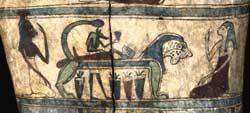
One motif that is very common on mummy coffins is the deceased lying mummified on a lion-shaped table. Anubis, the god of embalming, is bending over the deceased, often with a jar of oil in his hand. Isis and Nephthys are sitting on either side of the table. Under the table are the canopic jars containing the mummified entrails of the deceased. Nephthys and Anubis helped Isis when she revived her husband in the Osiris myth, and the image clearly shows that the mummification reflects the myth of Osiris’s resurrection.
But the dead in the underworld were not just an aspect of Osiris’s divinity and the sun god’s eternal circuit between heaven and earth. The afterlife in many ways resembled earthly life. The ushabtis were meant to serve the
deceased and tend the fields. The scenes depicting ritual offerings suggest that the deceased needed food and drink.
The Egyptians had a love for saying one and the same thing in many different ways. The apparently infinite variety of texts, images, symbols, and signs in an ancient Egyptian tomb is a shining example of this. Everywhere you look, the same story is told again and again: the successful journey of the dead to the underworld, their union with the god, and the blessed life everlasting. Continually repeating this theme, through artistic «creation» and the divine hieroglyphs, was a way of magically ensuring that the death journey would have a successful outcome.
Thus the entire complex burial ritual was one large magical spell that was cast to assist the deceased on a safe journey into eternity.
Animal mummies
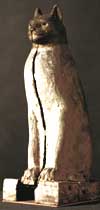
Photo: Eirik Irgens Johnsen
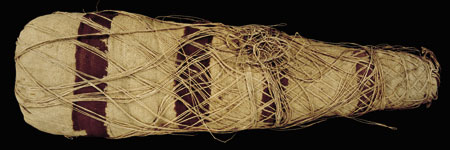
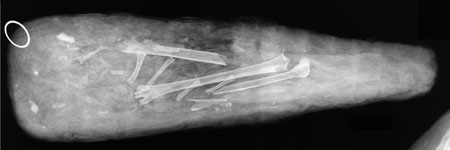
Animals were also mummified in Ancient Egypt. There are three main types of animal mummies. The least common is the mummified pet. Such mummies appeared in royal tombs and tombs of high-ranking officials. The animals had been their pets in their earthly life, and they wished to have them along in the next.
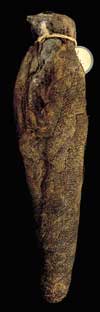
and mummified falcons were sacrificed to the god in his temple. C47687
Photo: Ann Christine Eek
More common was the mummification of animals that had been worshipped as deities while still alive. Most Egyptian gods were associated with animals, and in many temples these animals were worshipped. The most well-known animal cult belonged to the Apis bull in Memphis. The Egyptians believed the bull was a manifestation of the god Apis in the same way as the king was an earthly manifestation of the god Horus. When a calf displayed the special markings of Apis and was identified as sacred, it was treated as a god throughout its entire life, and when it died it was mummified and embalmed in the same way as a high ranking person. The dead Apis bulls were buried at the temple Serapeum, among the royal and noble people in the Memphis necropolis
Saqqara.
Mummified animals were also used as offerings to the gods in temples. Initially, pilgrims brought their own mummies as a gift to the temple. In time, the temple made their own mummies, which were sold to the pilgrims, who in turn offered them to the temple’s gods. The animals were ritually killed at a certain age and placed in recesses in catacombs under the temples. It is claimed that the sheer number of these mummies found in the archeological excavations around the turn of the 19th century was so great that they were used to fuel the steam locomotives in Egypt. The largest temples known to have had these kinds of animal catacombs belonged to the gods Thoth (the baboon and ibis), Bastet (the cat), Sobek (the crocodile), and Horus (the falcon).
As a side note, a number of animal mummies have been found that consist only of straw, earth, and clay mixed with some bone remains from previous offerings in the temple. These mummies are not fakes, but rather a result of the commercialization of offerings that took place in antiquity. There was such great demand for offerings at the temple that they eventually had to «cheat» a little. The museum’s collection contains two mummified falcons, a sarcophagus that contained the mummy of a cat, and a «fake» mummy of an ibis.