${resource:toc)
Introduction
It began around 3000 B.C., almost 2500 years before the Greeks established their famous city-states in the north-eastern Mediterranean. This culture gave birth to one of the first centralized governments in the world, and is one of the first places where people lived in a developing, organized society. Over the course of three millennia, Egypt was one of the most powerful of the Mediterranean countries in ancient times. We are still uncovering remains of the ancient civilization that was witness to the cultural blossoming that must have taken place in Egypt while we in Northern Europe were still living in the Stone Age.
From time immemorial the land in Egypt has been used for agriculture. The people lived in scattered settlements surrounded by farms, just as in other places in the world. They made their livings from farming, animal husbandry, hunting, and fishing. Their tools were primitive, mostly made from stone, wood, reeds, bone, and clay. This is how people lived in the Nile Valley for thousands of years, before one of humankind’s most important cultural revolutions took place around 3000 B.C. During this revolution, bronze came into use and written language was developed–the amazing hieroglyphics. During this same process, settlements and petty kingdoms were gathered under a single monarch (the pharaoh), and an effective state administration emerged.
The ancient Egyptians referred to this revolution as a concrete historical event -namely the unification of Upper and Lower Egypt under the legendary King Menes. Modern research, however, has shown that this «revolution» was a process that unfolded over about 1000 years. It was a result of technological innovations in agriculture and metallurgy, and not least the invention of hieroglyphics. The written word made an advanced central government possible. A learned scribe class arose around the pharaoh’s court, and these learned men soon gave rise to «scientific» disciplines such as astrology, medicine, and theology. Advanced ideas about deities, the creation of the world, and the role of
people on earth were written down and passed on to future generations, who developed the ideas further. Hand in hand with the new religion, a state ideology was developed that legitimized the new social order where the pharaoh had absolute power.
The ancient Egyptian religion was more than a political ideology. Through meticulous studies of nature’s various creatures, heavenly bodies, and the cyclical repetitions in nature, the ancient Egyptians developed highly advanced ideas about life—and not least about death. A large number of myths about death and the afterlife, often based on studies of the night sky and other natural phenomena, were woven together to a powerful and intricate world of ideas. These ideas were just as real to the ancient Egyptians as the theory of evolution and the Big Bang theory are to us today.
The culture of Ancient Egypt would survive for more than 3000 years. The Roman conquest of Egypt in 33 B.C., and the spread of Christianity a couple of hundred years later, marked the end of the Pharaonic Era. In some areas, however, the ancient Egyptian religion and culture lived on much longer. It was not until A.D. 540, when Roman emperor Justinian closed the Temple of Isis on the island of Philae, that the final remnants of the ancient Egyptian culture disappeared for good.
The Land by the River
Without the Nile, Egypt could not have existed –neither today nor 5000 years ago. Since rain almost never falls in Egypt, it is the Nile that irrigates the fields and provides drinking water for both people and animals. The river carried the sewage out of the cities, and was the main artery of transportation for the people of the Nile Valley up to the present time. The annual summer floods both irrigated and fertilized the fields until the construction of the High Dam at Aswan in the 1960s.
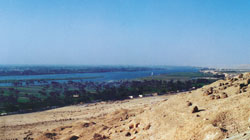
But as much as the Nile was a blessing for the land by the river, it could also be a curse. Agricultural production was completely at the mercy of the floods, and if the floods failed, so, too, did the crops. Famine and suffering could result. The flood began at the same time every year and was so precise that the Egyptians could base exact calendars on it; but the water level varied dramatically. If it was too low, there was drought; if it was too high, it washed away the topsoil and could even flood the cities. Modern research has shown that a series of insufficient floods was responsible for bringing the Old Kingdom to an end in about 2160 B.C., thus thrusting the country into hundreds of years of anarchy and economic, political, and cultural recession.
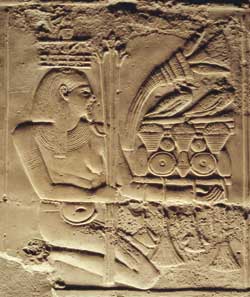
The ancient Egyptians elevated the Nile—or more precisely, the Nile flood–to the status of a god, who was represented in all of the great temples. The Nile god Hapy is often presented as a corpulent and perhaps androgynous figure, with a headdress of flowers and plants, often bearing an overflowing platter with food of all kinds. He symbolized the bounty and wealth that the Egyptians could harvest from nature, and on which the powerful Egyptian kingdom was based.
The Nile was the geographical feature that bound the kingdom together. Similarly, the country’s natural borders worked to isolate the fertile Nile Valley from other cultures. Toward the west lay the vast Sahara desert like a sea of burning sand. Toward the east lay the Sinai Mountains and the Eastern Desert, which terminated in the Red Sea. Toward the south lay the Nubian Mountains, with their treacherous terrain and hostile climate.
Toward the north lay the Mediterranean Sea. While today we think of the sea as an effective artery for transportation, it was altogether another matter for ancient Egyptian sailors. Nautical technology was not particularly advanced, and only in dire emergencies would anyone venture to cross the seas. This also prevented contact with other civilizations. It is not possible to understand the ancient Egyptian culture without understanding Egypt’s geography; the geography goes a long way to explaining how the culture could last over 3000 years, maintaining its identity throughout.
Historical Highlights
Ancient Egyptian history is characterized by continuity. Still, culture, language and religion evolve over time. The various periods in Egypt’s history each have their identifying features, and the division of ancient Egyptian history into epochs was attempted even in ancient times. Around 200 B.C., the Egyptian priest Manetho wrote down a historical overview in Greek of the Egyptian royal families or Dynasties. With only minor modifications, Manetho’s thirty dynasties are still used today.
In addition to these dynasties, scholars divide Egyptian history into four «golden ages»: The Old Kingdom, the Middle Kingdom, the New Kingdom, and the Late Period, which marks the end of Ancient Egypt’s period of greatness. The periods are separated by three intermediary periods that were more or less characterized by political decentralization and/or cultural stagnation (see the chronology).
The kings in the Old Kingdom (ca. 2686– 2160 B.C.) established standardized systems of religion, state power, and art that would typify the Egyptian culture for the next 3000 years. Religion and political ideology were tightly intertwined, and art became an expression of this ideology. The proportions, motifs, and the unique perspective used in Egyptian art adhered to set rules that were stipulated by the highest powers. Since there were no competing authorities who could pay the artists, the pharaoh and his priests alone could dictate the formal aspects of art. Thus a particular and relatively uniform mode of artistic expression was born and passed on to future Dynasties, keeping its characteristic style largely intact. It is also important to note that the art had a purely practical role as part of the state’s propaganda apparatus, and the actual term «art» thus held a very different meaning than it has for us today.
A testimony to how successful this system of government was are the majestic pyramids constructed near the capital city of Memphis and the principal cult center of the Sun God in Heliopolis, both located near the modern city of Cairo. This powerful kingdom fell toward the end of the third millennium B.C. One of the reasons for its demise may have been the series of insufficient Nile floods that destroyed agricultural production, the surplus of which was the basis of royal power. In the First Intermediate Period (ca. 2160–2055), the centralized state power was broken up into a number of petty kingdoms that were at constant war with one another. This atmosphere of political unrest hindered the development of theology, art, literature and architecture, and stagnation is readily apparent in the archeological sources.
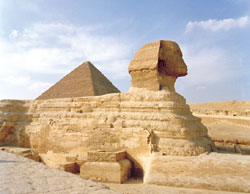
The Middle Kingdom (ca. 2055–1550 B.C.) was established when the country was again united under a single king. The legacy from the Old Kingdom was developed further, but not without modification. Among other things, construction of the great pyramids stopped. By the end of the Old Kingdom this tradition was changing. Instead of building enormous, massive pyramids, a new technique was adopted that made it possible to construct larger rooms within the stone structures. The angles and the measurements of the pyramids became standardized using the small pyramid of Menkaure in Giza as a model, but the internal structure became far more advanced. It also became more common to build with brick rather than stone, which is why so few of the pyramids from this period have survived.
The Middle Kingdom is known particularly for its advances in literature and the art of writing. Long narratives from this time have survived to the present, such as the well known works The Story of Sinuhe, The Tale of the Shipwrecked Sailor, Three Tales of Wonder, and The Dispute between a Man and His Ba, from which this booklet’s introductory poem is taken. The art of writing reached new heights, and written language and grammar became standardized. Later, this written language gained a status comparable to the role of Latin in medieval Europe. The spoken language developed in various directions, but the written language of the Middle Kingdom remained the common language for the learned and the
literate.
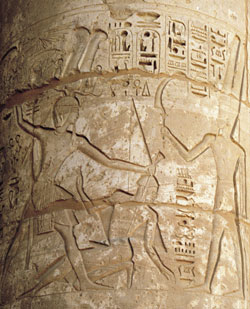
The Second Intermediate Period (1650–1550 B.C.) is again a period of political decentralization—this time caused by an invasion in the northern region by an unknown people, the Hyksos. Archeological finds suggest that these invaders were of a west Asian origin. Nevertheless, the 17th Dynasty continued to rule from the town of Thebes (modern day Luxor), and this dynasty was eventually able to reclaim the northern territories for the Egyptians. This ushered in the 18th Dynasty and the New Kingdom (ca. 1550–1070 B.C.).
More than any others, the 18th and 19th Dynasties of the New Kingdom represented Egypt’s golden age. During this time, a large empire was founded, and trade, handicrafts, art and architecture blossomed like never before. Most of the pharaohs that are familiar to people of the modern age, such as Hatshepsut, Thutmose III, Akhenaten, Tutankhamon, and Ramses II, belong to this period.
The empire fell during the 20th Dynasty, and the pharaohs lost their international prestige. The period of the 21st–25th Dynasties, referred to as the Third Intermediate Period (1069–664 B.C.), was again characterized by political unrest. The kingdom disintegrated from within, and external forces posed a growing threat. Libyan and Nubian rulers entered into the fray, and actually held most of the power in the country throughout most of the period. This trend became even more pronounced in the Late Period (664–332 B.C.), except the Libyans and Nubians were supplanted by Assyrians and Persians.
When Alexander the Great conquered Egypt in 332 B.C., Egypt lost its self-government for good. His general Ptolemy I Soter founded a dynasty that lasted until Queen Cleopatra (VII) again lost the country to the Romans in 33 B.C.
The end of the New Kingdom at the Historical Museum
The exhibit hosted by the University Museum of Cultural Heritage (UKM) entitled «The Mummy Lives! Eternal Life in Ancient Egypt» presents the Egyptians’ burial customs and ideas about life and death. The exhibit displays objects primarily from the last 1000 years of the Pharaonic Era.
The last 1000 years of Ancient Egypt’s history were marked by political turbulence, and the country was under tremendous pressure from foreign powers. But this period also carried with it the heritage from the New Kingdom, and this cultural tradition thrived surprisingly well throughout these difficult times.
The extended contact with foreign countries not only gave rise to unrest, but also exposed Egypt to new influences and ideas that stimulated technological innovation and affected the Egyptians’ perception of the world around them. For example, cosmology, the study of the universe and humankind’s place in the world, which was previously limited to the Nile Valley, became more universal. Through war, diplomacy and trade, the Egyptian empire’s contact during the New Kingdom with distant countries and new peoples increased the Egyptians’ awareness of the world around them. In theology, the gods were no longer simply gods of Egypt, but became universal gods. Likewise, in the creation myths, it was no longer just Egypt that was created, but rather the whole world. The myths tell how the god of creation wisely created a «Nile in the heavens» for foreigners who did not have a Nile of their own. Egyptians, who were not used to rain and received all their water from the Nile, began to include the surrounding world in their world view.
At the beginning of the 21st Dynasty, with the empire long since fallen, Egypt entered a new phase that to a large extent was to characterize the next 1000 years. The country’s international prestige plummeted. In military terms, the pharaoh had his hands full defending Egypt’s borders against increasingly frequent attacks from foreign powers. Without income from the former colonies, the pharaoh’s power was weakened, leaving him vulnerable to competing forces within the country. The capital city was moved from Thebes in the south to the delta in the North. The Amon priesthood at the Temple of Karnak in Thebes took over the administration of the southern regions of the kingdom. The high priest soon became just as powerful as the pharaoh himself, although he was formally subservient to the pharaoh in the north.
Despite all of the difficulties, this dynasty nevertheless left its mark in terms of both art and religion. Religion and religious art were nurtured under the strong Amon priesthood, particularly in Thebes. While this dynasty produced a wealth of monuments and objects of art, it is undoubtedly the mummy coffins that have made the greatest impression on the modern mind. Never before had such beautiful coffins been made for non-royalty in Egypt, and neither before nor after this period were mummies embalmed with such care and skill as they were at this time. Two mummy coffins from this Dynasty are included in the exhibit.












