Mummification
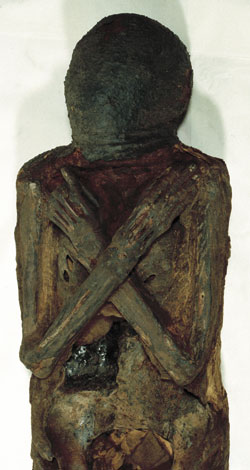 The word «mummy» originates from the Arab or Persian word moumia, and refers to the word «bitumen» (pitch or tar), the substance that was originally thought to have been used by the Egyptians to preserve the bodies. The ancient Egyptian word sah describes the holy state of the mummy after a successful mummification process.
Just as the soul had to endure a process or journey before reaching the blessed afterlife, the body also had to be subjected to a ritual process. A sah refers to a dead body that has gone through the meticulous religious ritual that mummification entailed.
Unfortunately, there are very few Egyptian sources that describe the mummification process in detail. But some diligent Greek writers committed to paper their experiences from «exotic» Egypt. Herodotus, who traveled through Egypt around 450 B.C., is the most well known of these early historians. He tells of the mummification process and writes that there were three different standards of mummification, depending on how much the deceased could afford. We can also discern much about the process from the mummies themselves.
A relatively recent research method that has provided valuable insights is attempts to create mummies by following traditional ancient Egyptian methods. These experiments were first performed on birds and animals, and in recent years also on humans.

Techniques

As a rule, mummification was generally performed by a special class of priests who had this skill as their livelihood. Embalming took place in designated locations. The washing took place in a separate cleansing chamber, and the other steps in the mummification process were carried out in a separate small building called per nefer («house of beauty»). The entire ritual took 70 days. The simplest form consisted of only a ritual cleansing, drying or desiccation, and finally bandaging. The most advanced form was a considerably more complex process.
Ritual cleansing was an absolute necessity before the mummification process could begin in earnest. Washing the body cleansed it of impurities–a first step on the path to becoming a sah, a being filled with holiness, purity, and vitality. This phenomenon is also encountered in modern religions, such as baptism in Christianity and the ritual washing before entering a mosque in Islam. Ritual cleansing is more than an everyday bath; the water removes not only superficial dirt, but also spiritual impurities connected to the dead human body.
Evisceration was the second step in the mummification process. The internal organs that were the first to decay had to be removed quickly so that the body could be preserved. The priest first made a small incision down on the left side of the abdomen. The organs were then removed through this aperture to be washed, salted, and bandaged in the same way as the rest of the body. The brain was removed through the nose. A metal probe and small chisel were used to break through to the cranial cavity through the nostril. A long, thin bronze hook was used to liquefy the brain so that it could be poured out through the nose. Because the heart played an important role as a witness in the trial of the deceased that took place in Osiris’s throne room, it was left in the body, often protected by an amulet.
Up until the end of the New Kingdom, it was common practice to place certain organs in four separate containers called canopic jars. The jars often had stoppers shaped like the heads of the four sons of Horus. Their task was to protect the mummified viscera against any dangers that might arise on the way to the underworld. There, they would be reunited with their master and serve him or her for all eternity. Starting in the 21st Dynasty, it became more common to place the organs back in the abdominal cavity after desiccation. The jars were nevertheless placed in the tomb, even though they were empty.
Drying (desiccation)
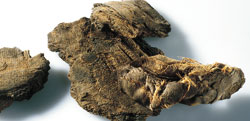
natural shape after the viscera were removed from the torso. C 47710.7. Photo: Ellen C. Holte
It is the body’s fluids that cause it to decay. Removing the moisture from the body makes it possible to hinder decomposition. Egyptians used natural salt (natron) for this purpose. Natron is found in large amounts around the lakes in Egypt. It is fortunate that the Egyptians had such large amounts of natron available because each body had to be completely covered by a small mountain of this substance so that the dehydration would be complete.
A special bench was used as a bed for the body, with support under the back and legs so that the natron would be able to reach the underside as well. Here, the body would remain for 40 days, at which point the body would be up to 75 percent lighter, and ready for anointing and bandaging.
Anointing had both ritual and practical significance. Sweet-smelling oils and aromatic resins had a ritual function, as when kings are anointed in the Old Testament. Anointing created an aura of holiness around the deceased. The oils also made the desiccated body more flexible so that the arms could be folded respectfully across the chest. The melted resin, which also acted as a disinfectant, was poured generously over the body and into the abdominal cavity. Resin was also poured over the mummy after the bandages were in place. Later, resin was replaced by pitch or natural asphalt that was imported from Persia.
Bandaging was a painstaking process. Each body part was carefully and separately wrapped. The process began with the smallest appendages–such as fingers, toes, and the male sex organ–and continued until the entire body was covered with several layers of bandaging. Estimates show that the total amount of linen used on each mummy could often add up to several hundred square meters. In order to procure the prescribed amount of linen, it often became necessary to use textiles the deceased had used during his or her lifetime.
The linen was also used as padding to make the mummy look more lifelike. The drying process shrunk the muscles, skin, and tissues and reduced the body to skin and bones. Pads of linen were placed in the abdominal cavity and under the bandages to reconstruct the body’s natural shape. During the 21st Dynasty pillows were sewn under the skin before desiccation.
Cosmetic surgery, adornment, and decoration
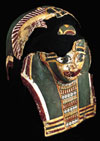
Photo: Ellen C. Holte
To enhance the mummy’s appearance, the Egyptians employed several tricks of the trade. It was common to braid artificial hair into the deceased’s hair so that it would look fuller and more beautiful. Glass eyes were sometimes placed in the empty eye sockets. Animal bones or wax could be used to support the nose so it was restored to its natural shape after the removal of the brain. Finally, the body could be decorated with cosmetic paint, both directly on the skin and on the outside of the bandages.
Mummification reached its peak during the 21st Dynasty, and this period has provided us with some of the best preserved mummies the world has ever seen. In subsequent periods, greater emphasis was put on the mummy’s façade than on the body underneath the bandages. Starting in the 22nd Dynasty, the mummies are often covered with a beautifully painted casing of cartonnage, a stiff but flexible material made from linen soaked in plaster and gum. The body itself was often in poor condition.
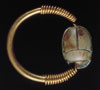
Jewelry was used for decoration, but also served other purposes. Amulets were believed to have magical powers. Every body part had its own protective symbol — either a divinity or an abstract religious symbol. The amulets were usually made from ivory or semi-precious stones such as lapis lazuli, jade, hematite, carnelian, or jasper. In graves of commoners, the precious materials were copied in wax, colored glass, or faience. Amulets were a part of the priests’ prescribed rituals, and were placed on the body according to a strict plan.
The placement of amulets on mummies peaked around the 26th Dynasty (ca. 664–525 B.C.). At that time, the number of amulets per mummy was about 53 or 54, placed as depicted in the figure.

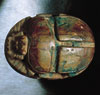
Photo: Lill-Ann Chepstow-Lusty
Of all the amulets, the heart scarab was considered the finest —and the objective of many grave robbers. The figure shows that the scarab was also used other places on the body. In the museum’s collection, there are many scarabs and other amulets, such as the Eye of Horus or wdjat, the Djed pillar, various divinities, a set square (see number 16 in the figure on page 33), a level for measuring horizontal surfaces, the papyrus column, head supports, as well as a number of hearts, a gazelle bound at the legs, and amulets from earlier times that are not included in the figure.
Funeral texts and the Book of the Dead
The coffin often contained one or more papyrus rolls. As a rule, the papyrus roll was placed on the body, under the outer layer of bandages, usually between the legs. These papyri containing texts and vignettes are called books. The Egyptian Book of the Dead is the most well known, and contains instructions on how to arrive safely in the underworld. Chapter 30b is about the actual trial that takes place in Osiris’s throne room, where the heart of the deceased is weighed against the feather of Ma’at. On the day of judgment, the heart is called upon as a witness to testify as to whether or not the deceased had lived a good and just life. The same chapter contains a magic formula that can prevent the heart from testifying against the deceased, whether it was needed or not.
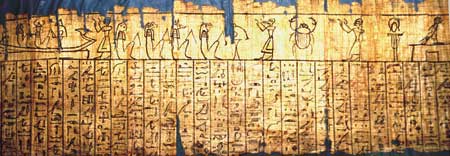
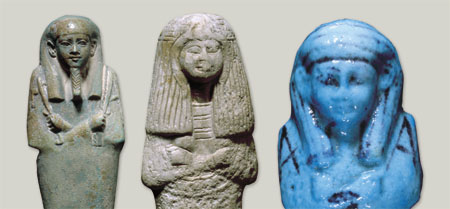
The texts also shed light over other objects that are often found in the grave. Chapter 6 in the Book of the Dead concerns the small mummiform statuettes, ushabtis, which are often found in tombs from the New Kingdom onward. The text is a magical formula that is supposed to give life to the figurines in the underworld. The inscription reads: «O, ushabti, who belongs to NN, if NN calls upon you to carry out necessary duties, to till the earth, to water the fields, and carry sand to the east or west, then you must say ‘I am here!’»
Coffins and Sarcophagi

When the mummy was ready, it was fitted with a death mask and placed in an anthropoid (human shaped) mummy coffin. The coffin was carried to the tomb where a sarcophagus stood ready to receive it. The death masks in the 21st Dynasty covered the entire body and are called mummy covers They were made of wood like the coffin lids, covered with gesso, and painted with a number of religious images and texts on a yellow background.
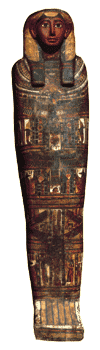
The sarcophagus, which in earlier times was rectangular and carved from stone, was starting in the 21st Dynasty made from the same material and in the same shape as the inner coffin and mummy case. The result was three layers of coffins with very similar appearances, but with different motifs. The motifs on the coffin were the same as on the papyrus rolls, and served the same purpose. Early in the 22nd Dynasty, the shape and decoration of the coffins changed suddenly and simultaneously throughout Egypt. This suggests that the pharaoh himself instigated the change.
Two of the museum’s coffins, C47713 and 14, are from the 21st Dynasty. The museum also has a mummy cover, C47714C, which belongs to the latter coffin. The artifacts originate from a burial chamber found in the desert on the west bank of Thebes. (The incredible journey from the shores of Thebes to the Ethnographic Museum in Oslo is described in Chapter 6.)
The coffin of «Dismut» (C47708) exemplifies the change that took place in the 22nd Dynasty. This coffin was probably made during the 24th Dynasty, and shows the development very clearly. The density of the motifs painted on the coffin is lower, providing a feeling of space and airiness not found on the coffins from the 21st Dynasty.
The coffins of the 21st Dynasty are deep boxes covered by a relatively flat lid. The newer coffins have a flat bottom more suggestive of a bed than a box, and the new lids are more rounded to cover the mummy. These coffins also have a kind of base under the feet, an artistic element borrowed from the royal stone sculptures that needed a base to stand upright. The coffin sometimes also had a slight rise in the back, comparable to the back reinforcements on the sculptures (this is not present on «Dismut’s» coffin).
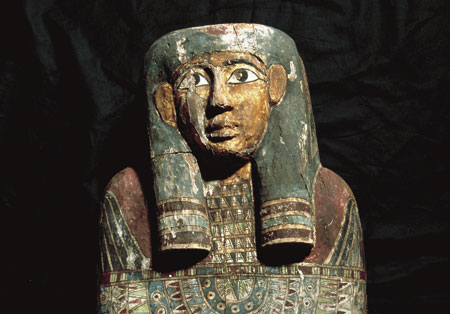
Photo: Ellen C. Holte and Lill-Ann Chepstow-Lusty












