Natural resources and rights
Nisga’a ownership declaration: We are Nisqa`a – the people who live in the Nass River valley of northwestern British Columbia. We have owned this land since time immemorial. We own it today. Since time immemorial we have lived in the Nass as members of an elaborate and complex society with our own cultural traditions, language, territorial boundaries and systems of government and law. Despite the arrival of Europeans and the introduction of their traditions, we remain a distinct people with inherent rights of self determination. These rights arise from ancestry, from the land and from the Creator.
Identity and living traditions
Woodcarving
Alver Tait is a Nisga’a man of the Northwest Coast of Canada. In 1992 he made this mask. This lead to him becoming the Nisga’a Nations most renowned artists, with the same status as a chief.
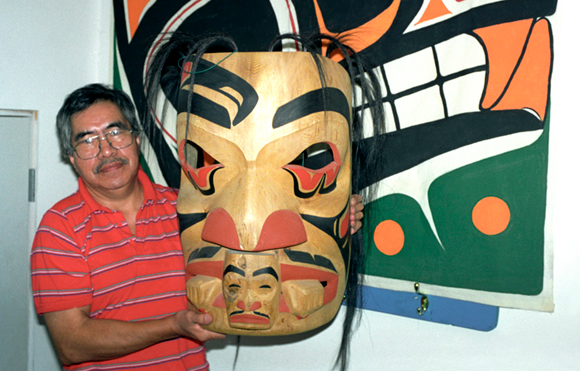
The mask is a self-portrait. The eagle on the right side of the forehead shows the owner’s clan membership and the colors black and red symbolize blood and live. The mask tells the history of how a normal person through dance becomes a kind of earthly being. Through the dance the dancers goes through a kind of rebirth.
Alver Tait used the mask during the ceremony for eight years and went through a transformation from fisherman to renowned artist; therefore it is called a transformation mask. After achieving his new status, Alver Tait chose to sell the mask to this museum.
The past on the Northwest Coast
Masks and pts’aaner People were very close to nature and their environment, especially the animal world. Masks and pts’aan (house posts), so-called totem poles, tell about the relationship between people and their sur- roundings in the Northwest Coast area. A pts’aan outside of each house in a village showed which family lived in the longhouse.
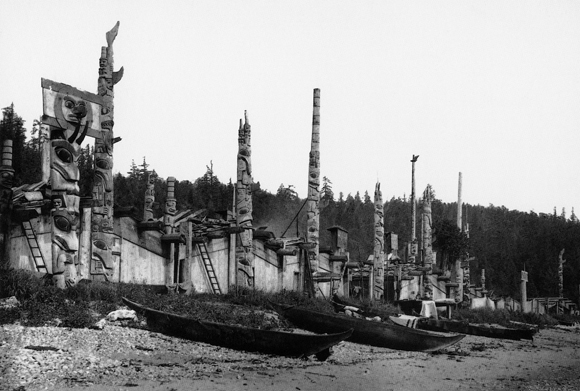
Kin groups owned the symbols, which followed the fam- ily over generations. The symbols showed and show fam- ily belonging and social status. Masks and pts’aans have over centuries been important for social life along the Northwest Coast.
Social organization. In the winter season the Northwest Coast groups lived in longhouses decorated with symbols and carved pts’aaner (house poles). Entire families, be- tween 40 and 60 persons, lived in a longhouse. The house was divided with walls made from cedar mats.
People, surroundings and resources. Natures bounty gave the possibility for permanent settlement in villag- es, and the riches were divided according to rank. The Northwest Coast had lush forest areas where people col- lected food for the winter supply. The men hunted and fished and the women picked berries and roots. The food was smoked, dried or preserved in oil. In the summer season the sea and rivers gave the most important basic needs.
The cedar tree. The cedar tree was and is important as a resource for Northwest Coast people. The cedar tree gave materials for houses, canoes, tools, clothes, baskets, mats, masks and pts’aaner.
Social life and traditions
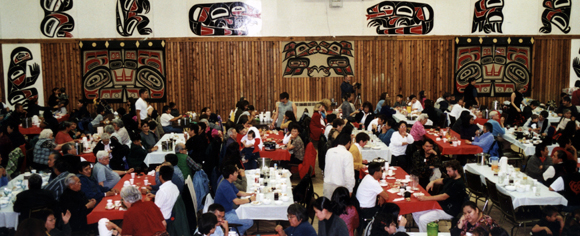
Potlatch consolidates status and distributes wealth. At the end of the 1800s the authorities tried to outlaw potlatch and other rituals. Nevertheless the tradition survived as a cornerstone in society for many groups along the Northwest Coast.
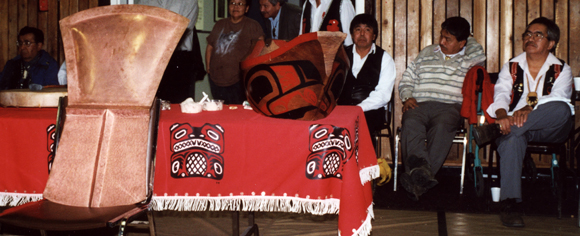
One who wants to strengthen their political status as leader or chief holds potlatch. The entire family group takes part in building up great wealth that will be given away at large potlatch celebrations. The per- son who can give away the most wealth and rather ends up completely without property, gains the position as the strongest and most generous leader. The rank symbols belong to the chief and his family. Before, pot- latch objects were valuable objects such as masks, blankets and copper plates, often decorated with symbols of rank.
Contact with Europeans led to the Northwest Coast peoples being hit by new diseases and many died. Later after an unusual number of chiefs died and many chief positions became available, too many potlatches were arranged. Wealth and riches were given away and later discarded and destroyed so that the givers could gain an advantage in the competition for chiefdoms. The authorities meant that this competition became somewhat out of control, so they authorities decided to ban potlatch ceremonies.
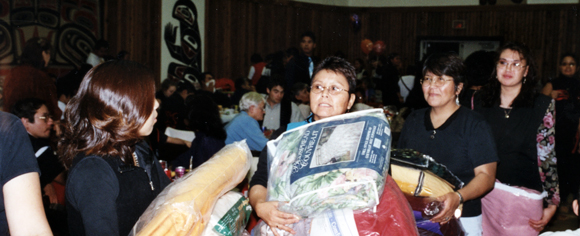
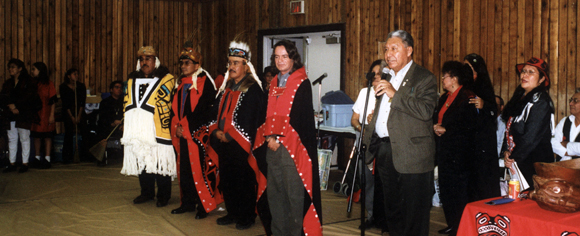
In 1952 the ceremonies were allowed again and today potlatch is a living tradition that includes the distribution of money and modern consumer goods.
Modern potlatch
Today average families hold a potlatch to mark special occasions, such as birthdays, weddings and completing important exams. Before, only political leaders and chiefs held such celebrations.