New boots on old tracks
After the Reformation in 1536, pilgrims vanished from the roads to Nidaros, today’s Trondheim. Protestants were not supposed to honour the saints, seek out relics or receive indulgences. The church taught that life itself was a pilgrimage along a difficult and dangerous path. This allegory was popularized by John Bunyan’s, The Pilgrim’s Progress. The following hymn echoes the same theme:
I am a guest in this world,
A stranger passing through.
My comfort on the journey:
My home is in heaven true.
In Norway as in the rest of Europe, there has been a revival of interest in religious travel in recent years. Pilgrims again follow paths to traditional pilgrimage destinations such as Selja, Røldal and the ruins of the Værne monastery in Østfold. However, most of the pilgrimage routes lead to Nidaros, Norway’s ecclestiac centre in the Middle Ages.
Pilgrimage routes to Nidaros
The church, in cooperation with local tourism and cultural organizations, is clearing old pilgrimage paths and opening pilgrims’ hostels. Some 2000 kilometres of marked paths, crossing more than 50 municipalities, now lead to Nidaros.
The Nidaros Pilgrims’ Centre, which opened in 2008, offers reasonably-priced accommodation for pilgrims, whether they come in organized groups or as individuals. As in medieval times, most pilgrims try to reach the city in time for Olsok, the 29th of July. Yet the number of pilgrims today is small compared to the Middle Ages, when the population of the city doubled during the St. Olaf Festival.
Why have walks along old pilgrims’ paths become popular again? Perhaps people are seeking quiet and inner peace in the midst of their stressful day-to-day lives? Others find fulfilment in experiencing the splendours of nature while on an environmentally friendly holiday. Some pack their rucksacks hoping that a slow-paced walk will create room for encounters with God and the Christian cultural heritage. The phenomenon can also be seen in light of modern tourism and prosperity - many people have already travelled the world and are now looking for something new and different..
Carrying stones to Nidaros
In the summer of 2006, a pilgrim walked all the way from Oslo to Nidaros with a stone in his rucksack. “This stone symbolizes my sins, and I am going to leave it outside the cathedral in Trondheim,” he explained. He and five other prison inmates walked the length of The Pilgrim’s Way to Nidaros in order to transform themselves and begin a better life.
Some people choose to go on demanding pilgrimage to do penance for something wrong they have done or to feel the suffering that others have to endure.
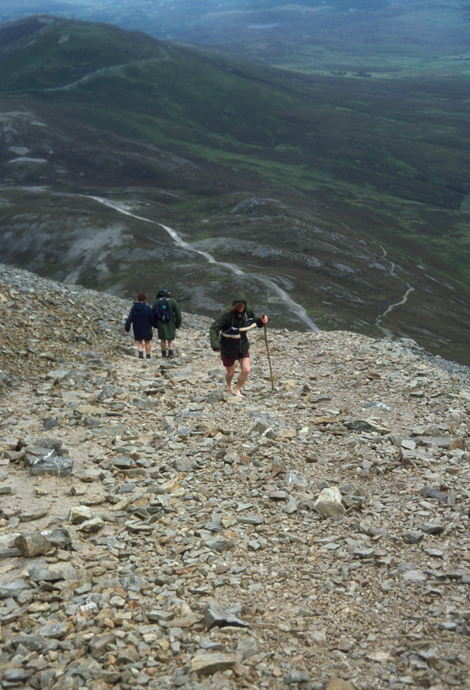
The man in this picture went on a penitential pilgrimage in his bare feet to Croagh Patrick in Ireland while his wife was at home suffering the pain of childbirth.
The path to enlightenment
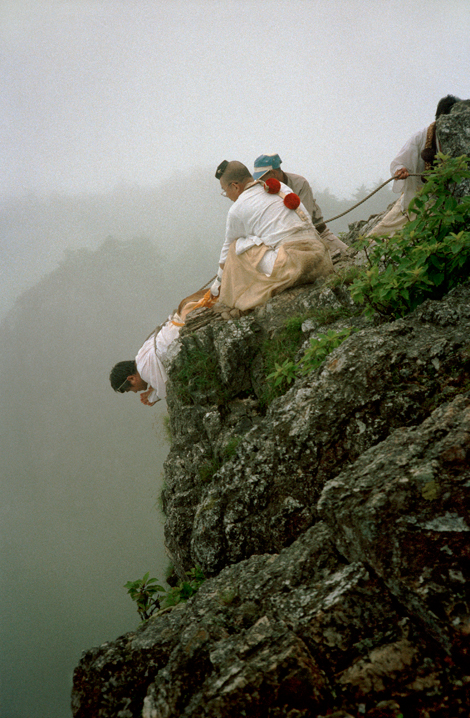
”Are you willing to sacrifice your life in the search for truth and enlightenment?” . Pilgrims on their way to the top of a sacred mountain in Japan face this question. One by one, they are suspended above a precipice to test whether they are worthy of reaching their goal.
These modern pilgrims are called Yamabushi, those who dwell in the mountains. A pilgrimage to a sacred mountain is a journey to the world of the gods and the Buddhas.
Santiago de Compostela
In 2006, Hege Høyer Leivestad spent seven months studying Santiago de Compostela in Spain as a pilgrimage city and tourist destination.
Hege worked at the church pilgrimage office, walked along the pilgrimage route, travelled with tourist buses, worked in the Franciscan reception-centre for pilgrims and sold souvenirs in the city centre. She found that Santiago was the destination for many different types of people. This fieldwork provided the material for ”No pain – no glory”, her master’s thesis in social anthropology at the University of Oslo.
Today Hege is a researcher at the Western Norway Research Institute. Here she shares some of what she learned about pilgrims and the city of Saint James in northern Spain.
Doing the Camino
For many pilgrims, walking the path is the very essence of the pilgrimage. While doing the Camino they pass through beautiful countryside, challenge themselves – and perhaps come face to face with themselves.
I met Carolina from Brazil, who decided to do the Camino after encountering problems both in her studies and in her love life. She needed to reflect on her life. Gradually, she learned to follow her own rhythm as she walked. Carolina felt that the Camino had changed her life. ”I didn’t know what to do with my life … I was completely lost … but now I’m doing much better.”
Others may suffer defeat. Gary from England was one of those who had to quit because his body refused to go on; he was not able to cover the required distance each day.
The sense of community among pilgrims is often expressed by the accessories they choose – a pilgrim’s staff and a scallop shell fastened to the pilgrim’s rucksack.
Church and commerce
The streets near the cathedral in Santiago are crammed with souvenir shops selling St. James figurines, scallop shells and T-shirts. Tourists and pilgrims alike purchase momentos and gifts from their travels.
A copy of El Botafumeiro, the huge censer that is used during the pilgrimage mass in the cathedral, is likely to have been made in China. However, if it is purchased in Santiago, a city rich in history and religion, it becomes meaningful nevertheless. “I have a wall at home for displaying objects like this.”, commented an enthusiastic Norwegian woman holding a St. James figurine.
”No pain, no glory”?
I walked the Camino with Miguel, a young Spanish doctor. He was clearly irritated by pilgrims who had their baggage transported by bus instead of carrying it on their backs. People wearing training shoes and without rucksacks are tourists, not pilgrims, he claimed. So he either speeded up or slowed down in order to avoid having to walk with ”fake pilgrims”.
Among a group of bus tourists from Norway, I met Torill from Oslo. She considered herself a religious person. Particularly after her husband died, she had dreamt of experiencing Santiago de Compostela. Even though she only walked a few kilometres along the pilgrimage route, she was delighted. ”I felt like a pilgrim as I walked!”
Who should be entitled to call themselves pilgrims?
Is the pilgrimage a religious act?
In order to obtain the most valuable momento of your expedition along the Camino, you have to visit the bustling pilgrimage office in Santiago. The reason is that you cannot buy the historic diploma called La Compostela in a souvenir shop. First you have to complete a form to confirm that you have walked the last 100 km or cycled the last 200 km to Santiago.
You are then required to tick the appropriate category indicating your motivation - is it religious, religious and other, or cultural? If you tick the third box, you are given a rather dull certificate of welcome. When I was working at the pilgrimage office I had to issue some of these. Determined walkers who discovered that they had not received the genuine diploma often came back to the office to complain!
Most pilgrims declare that they have a religious motivation for their journey to Santiago. Thus the Church can argue that the challenging walk along the Camino is a genuine religious act.
”Material things no longer matter”
Many pilgrims want to be close to nature, to be at one with the elements and to get away from the toil and bustle of everyday life. Part of the experience of simplicity is to stay at one of the many hostels (refugio or albuerge) along the way. Travellers have to show a “pilgrim’s passport” in order to sleep in one of the dormitories. The hostels charge a small fee or ask the pilgrims to pay what they feel the accommodation is worth.
These hostels allow modern pilgrims to live simply and frugally – perhaps with medieval pilgrims as their role models? In fact, “turista” is used as a term of abuse for pilgrims who are unappreciative and critical at the hostels and along the Camino.












