The Hajj – the great pilgrimage
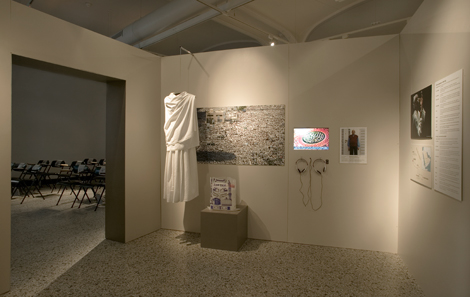
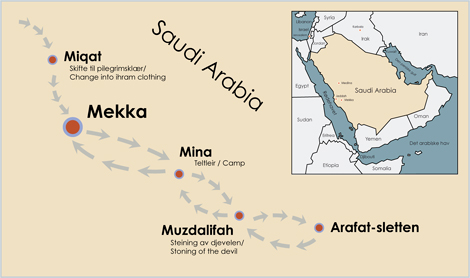
Every year some five hundred Norwegians make the pilgrimage to Mecca. On the first day of the Hajj, they gather around the Kaaba, a cube-shaped building that houses a black stone. Together with two million other pilgrims, dressed in white, they try to get close enough to kiss the stone. According to Islam, this is where God was worshipped for the first time.
The pilgrims then run seven times between two small hills. They do this to remember how the wife and son of the prophet Ibrahim desperately searched for water in the desert. God caused a spring of fresh water to burst forth, thus saving the lives of Hagar and Ishmael. Pilgrims still drink water from the same spring. When they return to their homes, they take holy water with them for those who were not able to make the journey.
The next day, the pilgrims make the journey to the Plains of Arafat, twenty kilometres outside the city. There they spend many hours in prayer and reflection. The prophet Muhammad also made a pilgrimage to this spot and gave his last speech here. A visit to the Plains of Arafat is required if the pilgrimage is to be a true Hajj.
The following day, the pilgrims throw small stones at three pillars to chase the devil away. Near the end of the Hajj, pilgrims sacrifice an animal and hold a great feast. Today, through the Internet it is possible to pay a volunteer organization to carry out the sacrifice and give the meat to poor people in the Muslim world.
The Hajj is one of the five pillars of Islam. All Muslims whose health and finances allow it, should visit Mecca once during their lifetime. The teeming crowds during the Hajj are a clear display of Islamic fellowship. At the same time, the task of organizing the Hajj is an enormous one for the Saudi government. 100,000 security guards are hired to ensure the safety of the pilgrims.
Little Mecca in Africa
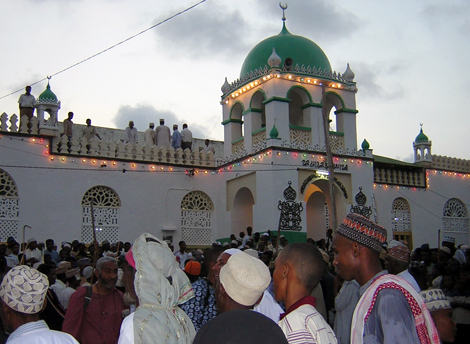
Lamu in Kenya has been called “Little Mecca”. East Africans who cannot afford the long journey to Saudi Arabia may choose instead to visit this historic city on the Swahili coast. This picture shows the celebration of the Prophet Muhammad’s birth outside the famous Riyadha Mosque.
Islam has a rich tradition of pilgrimages to the graves of saints. Some of the best-known destinations are the Shia shrines of the martyrs Husayn ibn Ali in Karbala (Iraq) and Imam Reza in Mashhad (Iran).
The Hajj – terms and concepts
al-Hajaru l-Aswad
The black stone in the Kaaba may possibly be part of a meteorite.
Dhu al-Hijjah
The Hajj is performed during the pilgrimage month ”Dhu al-Hijjah. The Islamic calendar is a lunar calendar and has 354 days in a year. In 2009 the Hajj begins on the 25th of November.
Eid al-Adha
Three-day feast at the end of Hajj during which animals are sacrificed in Mecca and throughout the world.
Hajj and Umra
The “little pilgrimage” to Mecca is called the Umrah and can be made at any time of the year. Muslims can perform the Umrah several times, but they make the great pilgrimage, the Hajj, only once. During the Hajj, pilgrims must visit Arafat as well as Mecca..
Hajji and Hajja
The honorary title for pilgrims who have performed the Hajj - Hajji for men, Hajja for women. Women who perform the Hajj must always be accompanied by male relatives.
Ihram
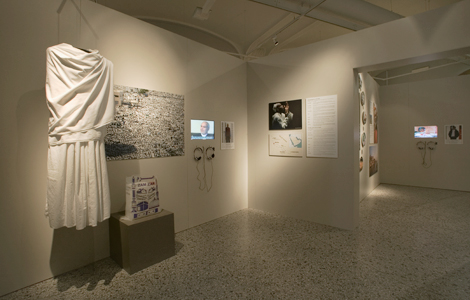
The word means initiation. Before the Hajj, pilgrims cleanse themselves through bathing and prayer. The men dress in two pieces of simple white cotton cloth (ihram), to symbolize that all pilgrims are equal before Allah. Women should dress with decorum (hijab).
Ibrahim
He was an important prophet who rebuilt the Kaaba when it had been destroyed. Married to Hagar and father of Ishmael, who is considered the father of the Arabs. Ibrahim is called Abraham in the Bible.
Medina
Pilgrimage city some 300 kilometres north of Mecca. Many pilgrims visit this city to see the grave and mosque of the prophet Muhammad.
Tawaf
Means ”ritual circling.” Pilgrims walk around the Kaaba seven times in an anti-clockwise direction.
Wukuf
Means stop, stay. Pilgrims gather on the Plain of Arafat for soul-searching, repentance and prayers for forgiveness.
Zam zam
Source of sacred water in Mecca. This spring suddenly appeared to Hagar and Ishmael, Ibrahim’s wife and son. Zam zam water is drunk for its healthgiving properties.
Poland’s Black Madonna
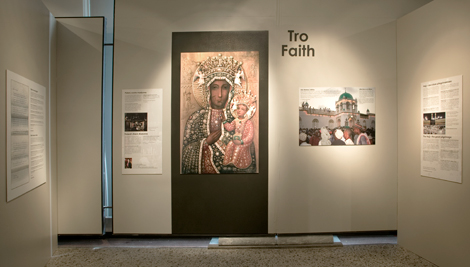
One of Europe’s most visited Catholic pilgrimage sites is a monastery in the Polish city of Czestochowa. Each year three million people come to see the painting of the Black Madonna. Behind an iron gate in the church, pilgrims can catch a glimpse of an icon with a dark Mary. According to legend, the apostle Luke painted this icon on a table that had been used by the family of Jesus.
The icon came to Poland in the 1300s. In the 1600s it was attributed with having saved both the monastery and the rest of Poland at the time of the Swedish invasion. For this reason the Black Madonna is also a symbol of Poland’s nationhood. During World War II, thousands of Poles defied Hitler’s prohibition and visited Our Lady of Czestochowa to offer her their prayers.
A group from the Catholic Church in Bodø went on a pilgrimage to Poland and Czestochowa in 2008. One of the pilgrims was Rolanda Kjelling. She has written a letter about her pilgrimage for this exhibition.
Letter from a pilegrim
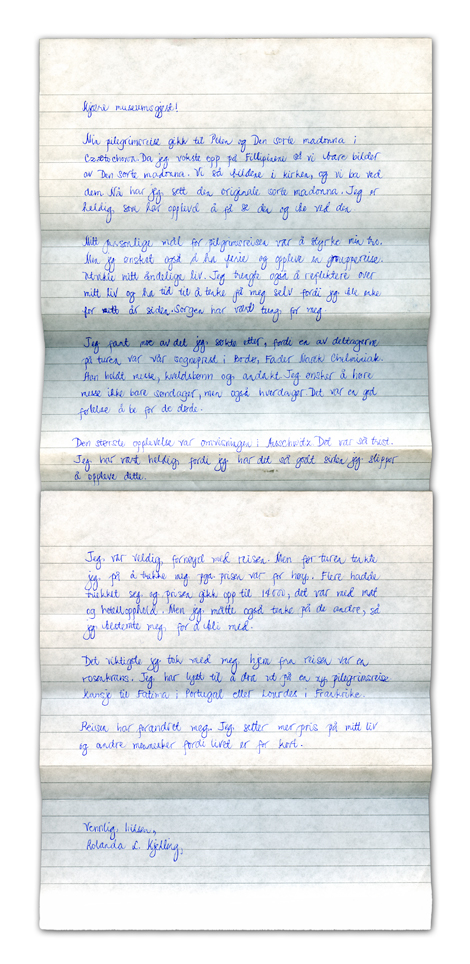
Dear museum visitor!
I have made a pilgrimage to Poland and the Black Madonna in Czestochowa. When I was growing up in the Philippines, we saw pictures of the Black Madonna. We saw these pictures in the church, and we prayed in their presence. Now I have seen the original Black Madonna. I am fortunate to have been able to see it and pray by it.
My personal goal for this pilgrimage was to strengthen my faith. At the same time I wanted to have a holiday and travel with a group, as well as to develop my spiritual life. I also needed to reflect on my life and have time to think about myself, as I became a widow a year ago. The grief has been hard for me to bear.
I found some of what I was looking for, as one of the members of our group was the parish priest in Bodø, Father Mare Chelminiak. He held mass, evening prayers and devotions. I wish to attend mass not only on Sundays, but on weekdays as well. It felt good to pray for the dead.
The most moving experience was the guided tour of Auschwitz. It was so sad. I have been fortunate; my life is good as I didn’t have to experience this.
I am very satisfied with the trip. But before we left, I was considering not going because the price was too high. Several others had dropped out, and the price went up to 14,000 kroner, including meals and hotel rooms. However, I had to think of the others too, so I decided to go along.
The most important thing I brought home from my trip was a rosary. I would like to go on another pilgrimage. Maybe to Fatima in Portugal or Lourdes in France.
The trip has changed me. I appreciate my own life and other people more, as life is too short.
Sincerely, Rolanda Kjelling